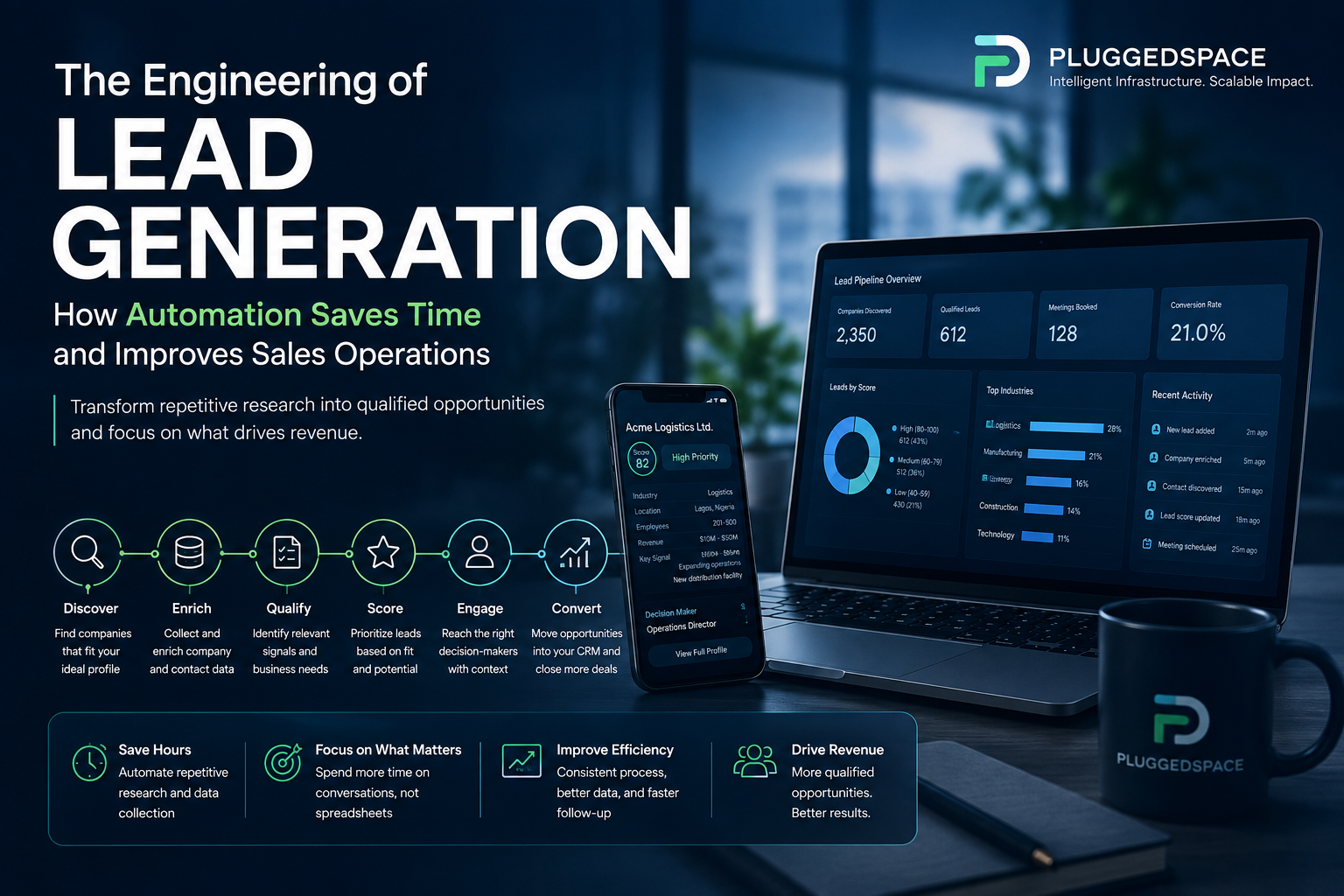
Lead generation is often described as a sales activity. In practice, it is also a data-processing activity.
Before a salesperson can have a meaningful conversation with a potential customer, someone usually has to identify companies, research their products and services, determine whether they fit the target market, locate relevant contacts, gather contact information, record the findings, and decide which prospects deserve attention.
Each task is relatively simple. The problem is repetition.
When the process is performed manually across dozens or hundreds of companies, the time required becomes significant. Sales teams can spend much of their working day researching prospects and maintaining information rather than speaking with customers.
Automation can reduce this administrative workload by turning lead generation into a structured information pipeline.
Lead Generation Is an Information Pipeline
A typical lead-generation process can be represented as:
Market ↓ Company Discovery ↓ Data Collection ↓ Enrichment ↓ Qualification ↓ Lead Scoring ↓ Decision-Maker Identification ↓ Outreach ↓ CRM ↓ Follow-up
Each stage produces information required by the next stage.
For example, discovering a company is not enough. The system may also need to determine:
- What industry does the company operate in?
- What products or services does it provide?
- Where is it located?
- How large is the organization?
- Does it appear to be expanding?
- Does it use technologies relevant to the offering?
- Does it have an identifiable business need?
- Who is likely responsible for the relevant decision?
- Is there a viable contact channel?
- Has the company already been contacted?
A manual process requires a person to perform much of this work repeatedly.
An automated system can perform many of these operations consistently and at significantly greater scale.
The Hidden Cost of Manual Prospecting
Consider a simplified research process in which a salesperson spends:
Activity| Approximate time Research company| 10 minutes Find relevant contacts| 5 minutes Record information| 5 minutes Qualify prospect| 5 minutes Total| 25 minutes
At 100 prospects, that becomes:
100 × 25 minutes = 2,500 minutes
That is approximately 41.7 hours of work.
This does not include writing proposals, conducting meetings, responding to prospects, negotiating, preparing quotations, or closing deals.
The issue is not that the salesperson is inefficient. The issue is that a large amount of their time is being consumed by repeatable information-processing tasks.
Automation changes the economics of the process.
For example, if automated collection and initial qualification reduce human research time to approximately five minutes per prospect, the same 100 prospects would require around 8.3 hours of human attention.
The exact savings will vary by industry, data quality, and workflow design, but the principle remains the same:
«Automation can move human effort away from repetitive data collection and toward activities that require judgment.»
What Should Be Automated?
Not every part of lead generation should be automated.
A useful distinction is between repetitive information-processing tasks and decision-intensive tasks.
Tasks well suited to automation
Automated systems can assist with:
- Searching for companies matching defined criteria
- Collecting publicly available company information
- Extracting information from websites
- Classifying companies by industry
- Identifying products, services, and business activities
- Detecting growth or operational signals
- Enriching company records
- Searching for publicly available professional contacts
- Detecting duplicate records
- Assigning preliminary lead scores
- Creating CRM records
- Updating lead statuses
- Scheduling follow-up activities
- Generating first-draft outreach messages
- Producing research summaries
These tasks involve structured rules, repetitive operations, or large volumes of information.
Tasks that still require human judgment
Humans remain important for:
- Defining the ideal customer profile
- Determining strategic relevance
- Evaluating complex business needs
- Approving sensitive outreach
- Selecting commercial offers
- Conducting sales conversations
- Negotiating
- Building relationships
- Closing significant contracts
Automation should therefore support the sales team rather than simply attempt to replace it.
Lead Scoring Reduces the Number of Prospects Requiring Attention
One of the most useful applications of automation is lead scoring.
Suppose a company has collected 500 potential prospects.
Treating all 500 equally would be inefficient.
A scoring system can evaluate each prospect against defined criteria.
For example:
Industry fit +20 Target location +10 Company size +10 Relevant technology +15 Recent expansion +15 Identified business need +20 Decision-maker found +10
Maximum score 100
The resulting score can then be used to prioritize the pipeline.
For example:
Score| Priority 80–100| High 60–79| Medium 40–59| Low Below 40| Review or exclude
The scoring model does not have to be perfect.
Its purpose is to help answer a practical question:
«Which prospects deserve human attention first?»
This becomes increasingly valuable as the number of potential companies increases.
AI Can Add Context to Lead Qualification
Traditional automation generally works with explicit rules.
For example:
IF industry = logistics AND company_size > 50 THEN score += 10
AI can operate on less structured information.
A system could analyze a company's website and identify statements indicating:
- expansion into new locations
- recruitment activity
- new facilities
- technology investments
- operational changes
- new product launches
- supply-chain requirements
- digital transformation initiatives
These signals may be difficult to represent entirely through fixed rules.
An AI-assisted system can convert unstructured information into structured observations that can then be used by the scoring system.
For example:
Company: Example Logistics Ltd.
Observed signals:
- Opened a new distribution facility
- Recruiting operations staff
- Expanding regional coverage
- Uses multiple operational systems
Potential opportunity:
- Infrastructure integration
- Workflow automation
- Monitoring systems
Lead score: 82/100
The important point is that AI is not creating certainty.
It is helping process information faster so that a human can make a better-informed decision.
Automation Can Also Improve Data Quality
Lead generation frequently produces another problem: fragmented information.
Without a structured system, prospect information may exist across:
- spreadsheets
- browser bookmarks
- messaging applications
- CRM records
- notes
- documents
- individual employees' memory
This creates several problems.
The same company may be researched multiple times. Contact information can become inconsistent. Follow-ups can be missed. Different members of the sales team may not know what another person has already done.
A centralized lead system can maintain a consistent record.
For example:
Company ├── Industry ├── Location ├── Website ├── Business signals ├── Contacts ├── Qualification score ├── Research history ├── Outreach history ├── Opportunities └── Follow-up tasks
This creates a common source of information for the sales process.
CRM Automation Connects Research to Sales
Lead generation is only useful when information moves into the operational sales process.
A research system that identifies prospects but leaves the information in a spreadsheet creates another manual step.
An automated workflow can instead connect prospecting directly to a CRM.
For example:
Lead discovered ↓ Lead enriched ↓ Lead qualified ↓ Lead scored ↓ CRM record created ↓ Sales task generated ↓ Human reviews lead ↓ Outreach approved ↓ Follow-up scheduled
This reduces the amount of administrative work between identifying an opportunity and acting on it.
It also creates a traceable record of what happened to each prospect.
Automation Does Not Mean Sending More Messages
There is a common misunderstanding that sales automation is primarily about sending large numbers of emails or messages.
That approach can produce poor results.
If the underlying data is inaccurate, automation simply allows inaccurate outreach to happen faster.
A company may receive:
- the wrong message
- the wrong offer
- communication from the wrong person
- duplicate outreach
- irrelevant follow-ups
The result can be reputational damage rather than increased sales.
The purpose of automation should therefore be process efficiency and better information, not simply message volume.
A more effective workflow is:
Discover ↓ Understand ↓ Qualify ↓ Prioritize ↓ Review ↓ Communicate
The human remains responsible for meaningful commercial decisions.
The Human-in-the-Loop Model
A practical sales automation system should allow different levels of automation.
Manual
The system provides research and recommendations, but the salesperson performs the actions.
Hybrid
The system performs research, enrichment, scoring, and administrative operations while the salesperson approves important actions.
Autonomous
The system performs predefined actions automatically within established rules and policies.
For most organizations, the hybrid model is a practical starting point.
It provides substantial automation while maintaining human control over important decisions.
A Technical Architecture for Automated Lead Generation
A modern lead-generation platform can be implemented as several connected components.
            ┌─────────────────────┐
            │ Discovery Sources   │
            │ Search / Web / APIs  │
            └──────────┬──────────┘
                       ↓
            ┌─────────────────────┐
            │ Data Collection     │
            │ Crawlers / Parsers  │
            └──────────┬──────────┘
                       ↓
            ┌─────────────────────┐
            │ Enrichment Layer    │
            │ Company / Contact   │
            │ Data Processing     │
            └──────────┬──────────┘
                       ↓
            ┌─────────────────────┐
            │ Qualification       │
            │ Rules + AI          │
            └──────────┬──────────┘
                       ↓
            ┌─────────────────────┐
            │ Lead Scoring        │
            └──────────┬──────────┘
                       ↓
            ┌─────────────────────┐
            │ Human Review        │
            └──────────┬──────────┘
                       ↓
            ┌─────────────────────┐
            │ CRM / Sales System  │
            └──────────┬──────────┘
                       ↓
            ┌─────────────────────┐
            │ Outreach / Followup │
            └─────────────────────┘
Behind these components, the system may use databases, search APIs, web extraction tools, language models, background workers, queues, and CRM integrations.
The implementation can be relatively simple for a small organization and become more sophisticated as the sales operation grows.
Measuring the Value of Automation
Automation should not be evaluated only by the number of tasks it can perform.
The more useful measurements are operational and commercial.
Relevant metrics include:
- Time spent researching each lead
- Number of qualified leads generated
- Percentage of researched leads that meet qualification criteria
- Time from discovery to CRM entry
- Follow-up completion rate
- Duplicate lead rate
- Salesperson time spent on administrative work
- Meeting conversion rate
- Opportunity conversion rate
- Revenue generated per salesperson
For example, reducing research time from 25 minutes to five minutes is useful only if the resulting leads are still relevant.
Efficiency without quality is not a successful sales system.
The objective is:
«More qualified opportunities per unit of human effort.»
The Role of Pluggedspace
At Pluggedspace, we approach this problem as an infrastructure and systems-engineering challenge.
Lead generation does not need to remain a collection of disconnected manual activities. It can be designed as an integrated workflow that combines discovery, data processing, qualification, scoring, human review, CRM integration, and follow-up.
The specific implementation depends on the organization.
A business with a small sales team may need a relatively simple workflow for identifying and qualifying prospects.
A larger organization may require more advanced capabilities such as:
- Automated prospect discovery
- Multi-source enrichment
- AI-assisted research
- Custom qualification rules
- Lead scoring
- Workflow orchestration
- CRM integration
- Approval systems
- Automated follow-ups
- Reporting and analytics
- Audit trails
The underlying principle remains the same: use software to handle repetitive information-processing work so people can focus on decisions and relationships.
Conclusion
Lead generation requires more than finding companies.
It requires collecting information, interpreting it, determining relevance, prioritizing opportunities, maintaining accurate records, and moving those opportunities into a sales process.
When performed manually, these activities can consume a substantial amount of time.
Automation can reduce this burden by performing repetitive tasks at scale, maintaining structured information, identifying relevant signals, scoring prospects, updating CRM systems, and supporting follow-up workflows.
The objective is not to automate every part of sales.
The objective is to allocate work intelligently.
Machines are well suited to repetitive processing, large-scale information collection, and rule-based operations. Humans remain better suited to judgment, relationship building, negotiation, and complex commercial decisions.
A well-designed lead-generation system combines both.
The result is not simply a faster way to find prospects. It is a sales operation that can process more information, maintain better data, respond more consistently, and give salespeople more time to perform the work that actually produces revenue.