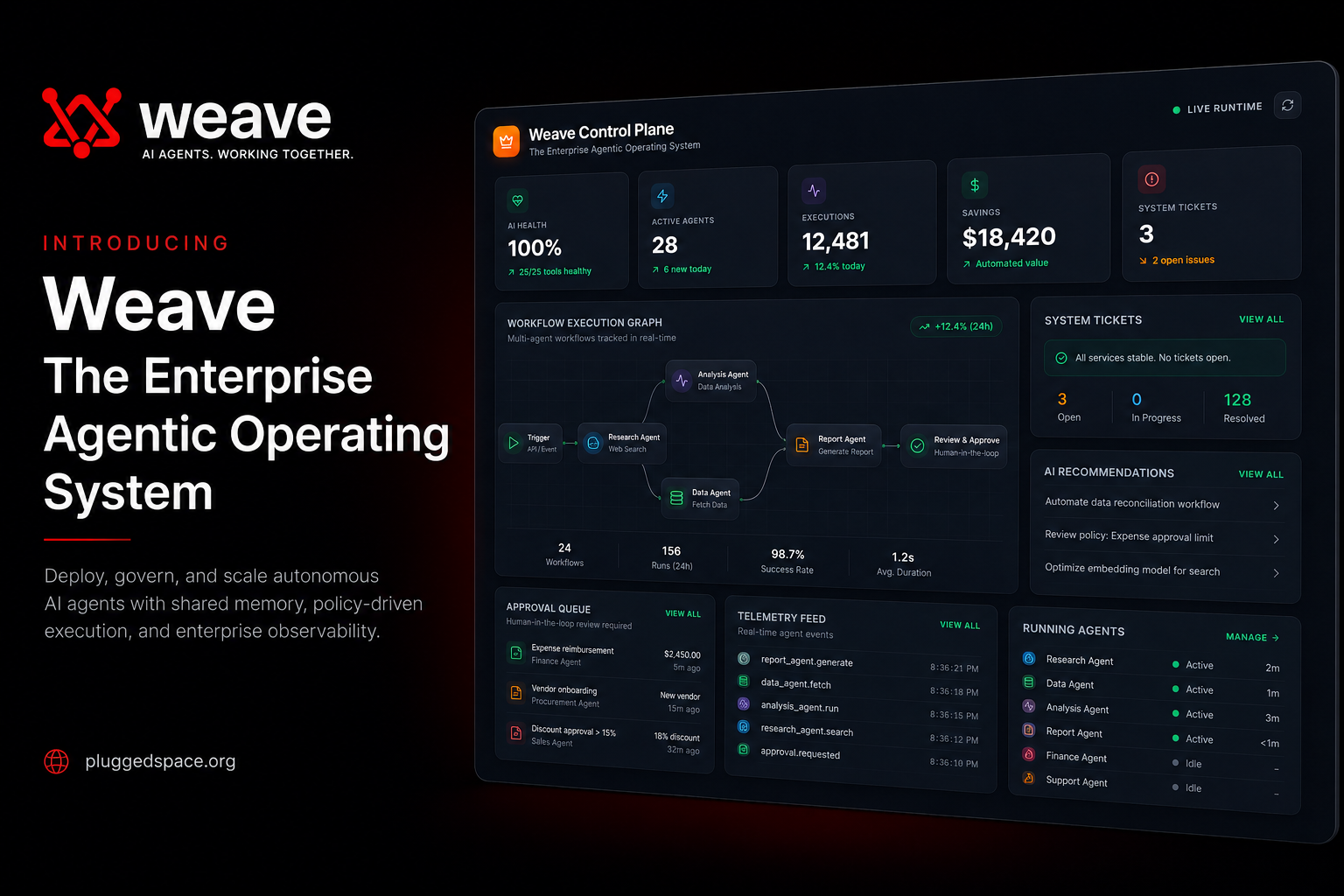
Introducing Weave: The Enterprise Agentic Operating System
By PluggedSpace Engineering Team Reading time: 8–10 minutes
Most companies do not have a problem with AI intelligence anymore.
They have a problem with AI operations.
It is easy to build a chatbot, a demo assistant, or a single-purpose workflow powered by an LLM. It is much harder to build a system that can safely coordinate multiple agents, preserve memory across workstreams, enforce business rules, support human review, and operate reliably inside a real enterprise.
That is the gap Weave was built to close.
Weave is an Enterprise Agentic Operating System for autonomous AI fleets. It is designed to help organizations deploy, govern, and scale AI agents as production infrastructure rather than isolated scripts. Instead of treating each agent as a separate experiment, Weave provides a unified operating layer for memory, policy, tools, observability, and orchestration.
If the first wave of enterprise AI was about prompts, the next wave is about systems.
AI Has Outgrown Chatbots
The first generation of enterprise AI adoption focused on simple interactions:
- answering customer questions
- generating marketing copy
- summarizing documents
- assisting developers
- drafting responses
- automating repetitive tasks
Those use cases were useful, but they exposed a hard truth: a chatbot is not a platform.
A chatbot can respond. A platform can operate.
As organizations increase their use of AI, the real requirements become obvious:
- agents need shared memory
- actions must be controlled
- sensitive workflows must be approved
- departments need isolation
- logs must be auditable
- systems must integrate with existing infrastructure
- performance must be measurable
- outputs must be governed
Once AI starts touching customers, money, compliance, internal systems, and production data, the problem stops being “can the model answer?” and becomes “can the system be trusted?”
That is the space Weave occupies.
The Real Problem Is Not Building Agents
The industry has made building an agent look deceptively simple.
You connect a model to a tool. You give it instructions. You attach a vector store. You ship a prototype.
Then production begins.
And production changes everything.
A real enterprise agent has to do more than generate text. It has to:
- remember context across sessions
- share knowledge securely across teams
- avoid cross-tenant data leakage
- execute tools only when allowed
- request approval when needed
- maintain a trace of every meaningful action
- survive real-world failures
- scale across departments and business units
Without a proper operating layer, agents become fragile. They become difficult to debug, impossible to govern, and expensive to maintain.
That is why most teams do not actually have an AI fleet. They have a collection of disconnected scripts.
Weave changes that.
Meet Weave
Weave is the Enterprise Agentic Operating System.
It is the infrastructure layer for deploying autonomous AI agents inside an organization without losing control of memory, policy, security, or observability.
At a high level, Weave gives companies three things:
- A governed execution layer for agent actions
- A shared memory substrate for enterprise context
- A modular fleet of agents and tools that can operate across business functions
Weave is not a chatbot wrapper. It is not a prompt library. It is not a toy agent builder.
It is the system underneath the agents.
What Makes Weave Different
1. A kernel for control
Every enterprise needs a control plane.
In Weave, that control plane is the kernel. It handles the operational responsibilities that agents should not be trusted to handle directly:
- authentication
- authorization
- multi-tenancy
- policy enforcement
- rate limiting
- event streaming
- approval routing
- audit logging
- system telemetry
This separation matters.
Agents should focus on reasoning and task execution. The kernel should focus on safety, governance, and coordination.
That architecture keeps the system maintainable and makes the platform suitable for real enterprise use.
2. BrainBox memory for shared intelligence
Most agents forget.
They forget what happened last week. They forget what another agent learned. They forget what the organization already knows.
That is unacceptable in an enterprise setting.
Weave solves this with BrainBox, a shared memory substrate designed to preserve context across workflows, teams, and sessions.
BrainBox is built to support multiple forms of memory, including:
- immutable event history
- semantic retrieval
- structured relationships
- inference caching
The result is a system where agents do not operate in isolation. They can build on prior knowledge, retrieve relevant context, and act with awareness of the broader business environment.
That is the difference between a disposable agent and an enterprise system.
3. Policy-driven autonomy
Autonomy without policy is just risk.
In Weave, agent execution is governed by a policy engine that defines what is allowed, what requires human approval, and what must be blocked entirely.
That means organizations can configure rules around:
- high-value actions
- sensitive workflows
- financial thresholds
- vendor operations
- compliance-sensitive decisions
- tenant-specific constraints
When an action crosses a limit or triggers a risk condition, the system can pause execution and route it to a human approval queue.
This is the right model for enterprise AI.
The goal is not to remove humans. The goal is to let humans supervise what matters while agents handle the repetitive work.
4. A fleet of domain agents
Most companies do not need one giant universal agent.
They need a fleet of specialized agents that solve different parts of the business.
Weave is designed around that reality.
It includes ready-to-deploy domain agents for tasks such as:
- customer support
- marketing and growth
- business intelligence
- compliance and governance
- finance and analysis
- maintenance and operations
- risk detection and monitoring
Each agent is focused on a domain. Each can use the same underlying operating system. That makes the platform modular, extensible, and easier to govern.
This is how you move from “AI assistant” to “AI workforce.”
5. Real tools, not pretend automation
Agents are only useful when they can do real work.
Weave includes a tool layer that lets agents interact with business systems, data sources, communication channels, and external services. That includes the kinds of actions enterprises actually need:
- send messages
- query data
- generate documents
- inspect files
- search the web
- perform analysis
- trigger workflows
- automate repetitive operations
The point is not to impress users with vague “AI capabilities.”
The point is to make useful systems that connect to the business.
6. Visibility into everything that happens
If an AI system cannot be observed, it cannot be trusted.
Weave is built with monitoring and execution transparency in mind. Teams can inspect:
- agent activity
- tool usage
- policy decisions
- memory interactions
- approvals
- failures
- execution history
That visibility makes the platform usable by engineering teams, compliance teams, and business operators alike.
It also makes debugging possible.
And in enterprise software, debugging is not optional.
What Weave Enables in Practice
The value of Weave is not only architectural. It is operational.
Here is what it looks like when the system is used well.
Customer support
A customer submits a request. A support agent retrieves context from previous conversations. If the issue involves billing, a finance agent can validate the transaction. If the request requires approval, the policy engine routes it to a human. The customer gets a faster response, and the business gets a complete audit trail.
Marketing operations
A marketing team can use an agent to generate content ideas, review campaigns, analyze performance, and prepare distribution workflows. Instead of disconnected tools, the team gets a coordinated operating layer for execution.
Compliance and procurement
A governance agent can check vendors, validate documents, flag risky purchases, and enforce policy before money moves. That reduces operational friction without removing oversight.
Finance and analysis
A finance agent can help summarize reports, identify anomalies, prepare internal briefs, and assist with planning. It does not replace financial leadership. It gives them faster access to relevant information.
Maintenance and operations
In environments with sensors, field systems, or physical infrastructure, agents can monitor signals, detect anomalies, and trigger work orders before issues become outages.
The pattern is the same across all domains: autonomous execution with controlled boundaries.
Why Enterprise Teams Need This Now
The market is moving past experimental AI.
Organizations now want systems they can actually deploy.
That means they need:
- stronger control
- better memory
- clearer auditability
- isolated tenants
- policy enforcement
- better observability
- fewer integration headaches
- less custom infrastructure
Building all of that from scratch is slow and expensive.
Weave gives teams the foundation so they can focus on the business problem instead of reinventing the platform around every agent.
That is the real opportunity.
Not “AI for everything.”
Infrastructure for AI that can actually run inside an enterprise.
Designed for Multi-Tenant Enterprise Use
Enterprise software lives or dies on isolation.
Weave is built with multi-tenancy in mind, which means organizations can keep data, memory, and policies separated across business units, customers, or departments.
That matters because enterprise AI does not run in a vacuum. It runs in a world of:
- sensitive information
- internal permissions
- regulatory concerns
- departmental boundaries
- customer trust
- operational accountability
When an AI system cannot isolate tenants, it becomes a liability.
When it can, it becomes infrastructure.
Built for Teams That Need More Than a Demo
Weave is intended for organizations that are serious about AI operations.
That includes teams that care about:
- enterprise governance
- production reliability
- secure execution
- shared memory
- approval workflows
- observability
- modular agent design
- real-world automation
It is for teams that understand a simple truth:
A useful AI product is not just a model. It is a system.
The Future Is Not One Agent
The future of enterprise AI is not a single omniscient assistant sitting in a chat window.
It is a coordinated fleet of agents, each with a role, each with a memory, each governed by policy, each connected to the systems the business already uses.
That future requires an operating system.
Weave is being built for that future.
It gives organizations the structure to deploy AI agents safely, the memory to make them useful over time, and the control layer to keep them accountable.
That combination is what turns AI from a novelty into infrastructure.
Closing Thoughts
Every major computing era has needed a new operating layer.
Servers needed operating systems. Cloud infrastructure needed orchestration. Modern software needed observability and deployment pipelines.
Autonomous AI now needs its own operating layer.
That is the problem Weave is built to solve.
Weave is the Enterprise Agentic Operating System for organizations that want to move beyond prototypes and build real AI infrastructure for the enterprise.
Not isolated scripts. Not brittle demos. Not unmanaged autonomy.
A system.
A fleet.
An operating model for autonomous AI.
Try Weave Today at agents.pluggedspace.org
Learn more at Pluggedspace.org/blog and follow the Weave roadmap as we continue building the infrastructure layer for enterprise agents.