If you deploy a Python script that calls an LLM API inside a loop, you can build an impressive prototype in an afternoon.
If you take that same script and run it across twenty concurrent business workflows touching production databases, it falls apart within forty-eight hours.
The reason has little to do with the intelligence of the underlying model. It happens because modern AI agents operate in a runtime vacuum.
When software developers write code, they take decades of operating system abstractions for granted. The OS allocates CPU slices, manages virtual memory, prevents processes from corrupting each other's address space, enforces user permissions, and isolates system faults.
With AI agents, developers are running autonomous, probabilistic processes with none of these safeguards.
There is no process supervisor. There is no memory management beyond raw context windows. There is no concurrency locking. And there is no standard error-recovery protocol when an external network call fails.
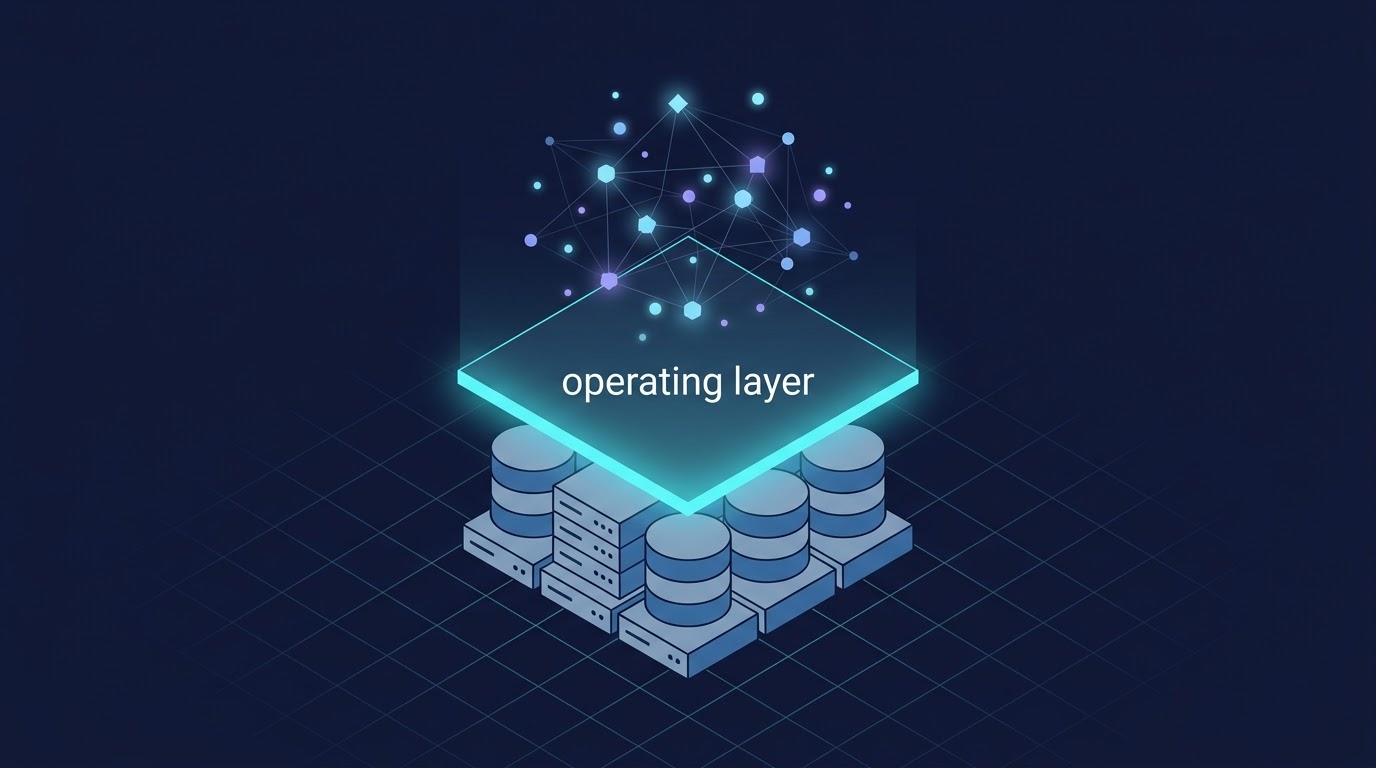
To run autonomous agents reliably in an enterprise, you need an operating layer.
The Four Runtime Failures of Unmanaged Agents
When companies move autonomous agents from isolated developer laptops into live production environments, four specific systems failures emerge:
┌─────────────────────────────────────────────────────────────┐
│                 THE RUNTIME VACUUM PROBLEM                  │
│                                                             │
│   [ Agent Process A ]               [ Agent Process B ]     │
│           │                                 │               │
│           ▼                                 ▼               │
│   Context Saturation               Unchecked Race Condition │
│   (Needle-in-haystack decay)       (Database overwrite)     │
│           │                                 │               │
│           └────────────────┬────────────────┘               │
│                            │                                │
│                            ▼                                │
│               NO SUPERVISOR / NO BOUNDS                     │
│               - Token budget blowouts                       │
│               - Circular delegation loops                   │
│               - Silent failures on 500 timeouts             │
└─────────────────────────────────────────────────────────────┘
1. State Drift and Context Saturation
An autonomous agent tasked with a multi-step objective—such as reconciling an inventory ledger against supplier invoices—executes dozens of sequential tool calls.
Each tool call returns JSON payloads, stack traces, or document chunks. In an unmanaged script, all of this output gets appended directly back into the conversational prompt.
This causes two severe breakdowns:
- Attention Degradation: As the context window expands past 50,000 tokens, the model's ability to recall instructions from the beginning of the run drops sharply. The agent begins repeating questions it already asked or violating constraints established in step one.
- Cost Runaway: Every step re-submits the entire accumulated history. A ten-step task that should cost pennies ends up reprocessing millions of tokens, generating hundreds of dollars in unnecessary API costs per workflow.
Without an operating layer managing context swapping and memory tiers, long-horizon autonomy is mathematically unsustainable.
2. Concurrency Deadlocks and Loop Thrashing
In any serious enterprise process, multiple agents must operate simultaneously.
Imagine an IT incident response workflow:
- Agent A is responsible for diagnosing error logs in AWS CloudWatch.
- Agent B is responsible for applying hotfix patches via GitHub Actions.
- Agent C is responsible for updating incident status in Jira and PagerDuty.
What happens when Agent A needs clarification from Agent B before finishing its diagnostic report, while Agent B waits for Agent A's initial log analysis before applying the fix?
Without a centralized scheduler enforcing Directed Acyclic Graphs (DAGs) and execution timeouts, the agents enter an infinite circular dependency loop. They consume API rate limits, exhaust compute tokens, and fail to alert human engineers.
3. Lack of Process Isolation and Data Bleed
In multi-tenant or multi-department environments, unmanaged agents share execution memory informally.
If a financial reporting agent and a human resources onboarding agent operate on the same unisolated runtime, context leakage becomes a serious risk. Prompt injection vulnerabilities or mishandled intermediate logs can expose sensitive employee salary records to unauthorized users or external API callbacks.
Traditional operating systems isolate processes using virtual memory boundaries and POSIX permissions. AI agents require identical isolation: process sandboxing, role-based tool credentials, and strict data-fencing across workflows.
4. Unrecoverable Faults and Missing Checkpoints
When an external API throws an HTTP 504 Gateway Timeout or returns a malformed schema, how does an unmanaged agent react?
Typically, the script crashes. The intermediate state evaporates, the context is lost, and the entire multi-step process must be restarted from scratch.
A reliable software system needs checkpointing. If step six of an eight-step workflow fails due to a network glitch, the runtime should capture a snapshot of the current state machine, trigger an exponential backoff retry, and resume from step six without discarding the work already validated in steps one through five.
What Does an Agent Operating Layer Actually Manage?
An operating layer sits between your foundation models (OpenAI, Anthropic, open-source weights) and your business infrastructure (PostgreSQL, SAP, Salesforce, AWS).
It acts as the traffic controller, security guard, and memory manager for your agent fleet.
Traditional Operating System     Agent Operating Layer
─────────────────────────────────────────────────────────────
Process Management (Init/Fork)   Agent Lifecycle & Schedulers
Virtual Memory (RAM/Paging)      Persistent Memory Substrate
System Call Interfaces           Governed Tool SDK
File System Permissions          Role-Based Access Control
IPC (Inter-Process Comms)        Verified Message Bus / DAGs
Process Watchdog / Syslog        Execution Tracing & Auditing
1. Process Lifecycle and Scheduling
The operating layer decides when agents spawn, when they pause, how dependencies are sequenced, and when they terminate. It replaces unconstrained while loops with state machines that enforce hard execution bounds, maximum token ceilings, and wall-clock deadlines.
2. Memory Swapping and Context Management
Instead of dumping raw conversational history into prompts, the operating layer handles context like an OS manages virtual memory. It keeps active variables in fast working memory, archives historical tool exchanges into structured episodic logs, and pulls relevant reference facts from semantic vector indexes only when needed.
3. Deterministic Policy Enforcement
The operating layer intercepts all outbound agent tool calls before network transmission. It validates payload arguments, checks spending authorizations, and applies Zero-Trust gates. If an agent attempts to drop a database table or execute a payment outside its pre-authorized allowance, the operating layer blocks the command instantly, regardless of what the LLM output suggested.
4. Step-by-Step Observability and Replay
Every state transition, model inference call, tool execution, and human approval is appended to an immutable execution trace. If an agent behaves unexpectedly, engineers can replay the execution graph node by node to diagnose exactly which input caused the deviation.
What the Operating Layer Must Provide
In practice, an enterprise operating layer exists to solve this runtime vacuum.
The operating layer provides the operational foundation required to run autonomous agents across mission-critical enterprise systems:
               ENTERPRISE DATA & SOFTWARE
       (HubSpot, PostgreSQL, SAP, GitHub, APIs)
                          │
                          ▼
            ENTERPRISE AGENT RUNTIME
  ┌──────────────────────────────────────────────┐
  │ - DAG Swarm Scheduler & Concurrency Control  │
  │ - hybrid memory substrate           │
  │ - Zero-Trust Policy Kernel & Dual-Key HITL   │
  │ - Isolated Tool Integration SDK              │
  └──────────────────────────────────────────────┘
                          │
                          ▼
                  FOUNDATION MODELS
           (Reasoning, Synthesis, Planning)
By decoupling the reasoning engine from the runtime environment, the operating layer ensures that:
- Workflows survive third-party model outages and API rate limits.
- Agent swarms coordinate via structured execution graphs with automated error rollbacks.
- Sensitive company data is protected by code-level authorization rather than fragile prompt instructions.
Architectural Takeaway
Large language models provide remarkable reasoning capabilities, but reasoning alone does not make a reliable system.
Just as software applications require an operating system to manage hardware resources, autonomous AI agents require an operating layer to manage state, concurrency, tools, and security.
Building reliable enterprise AI is not about finding the perfect prompt. It is about engineering the runtime environment that makes autonomous execution safe, repeatable, and auditable.
The runtime vacuum described here is why the foundations series treats the operating layer as a distinct architectural concern. Pluggedspace examines it separately from models and applications so execution guarantees can be reasoned about on their own terms.
- Deepen Your Technical Knowledge: Read our flagship breakdown on What Is an Enterprise Agentic Operating System?.
- Explore Labs Research: Read related systems research in Pluggedspace Labs.