A customer updates their shipping address in your portal.
Thirty seconds later, the update lands in Stripe. Two minutes later, an automated synchronization job pushes it to HubSpot. But the warehouse management system—running on an on-premise SQL database hooked to an overnight batch runner—doesn't see it. The order ships to an empty house three states away.
When the customer calls support, the support rep checks Zendesk. Zendesk pulls customer data through a custom webhook that timed out during the morning traffic spike. The rep sees the old address, assumes the customer made a typo, and triggers a replacement order.
Now you have two duplicate shipments, two conflicting database records, and four hours of engineering time burned tracking down why an address update didn't "flow through."
This isn't an edge case. It's the daily reality of enterprise system fragmentation across almost every software-enabled company between $10M and $100M in revenue.
The immediate reaction from management is usually predictable: "Our disconnected business systems aren't talking to each other. We need better integrations."
They're diagnosing the symptom. The disease is architectural fragmentation.
What is enterprise system fragmentation?
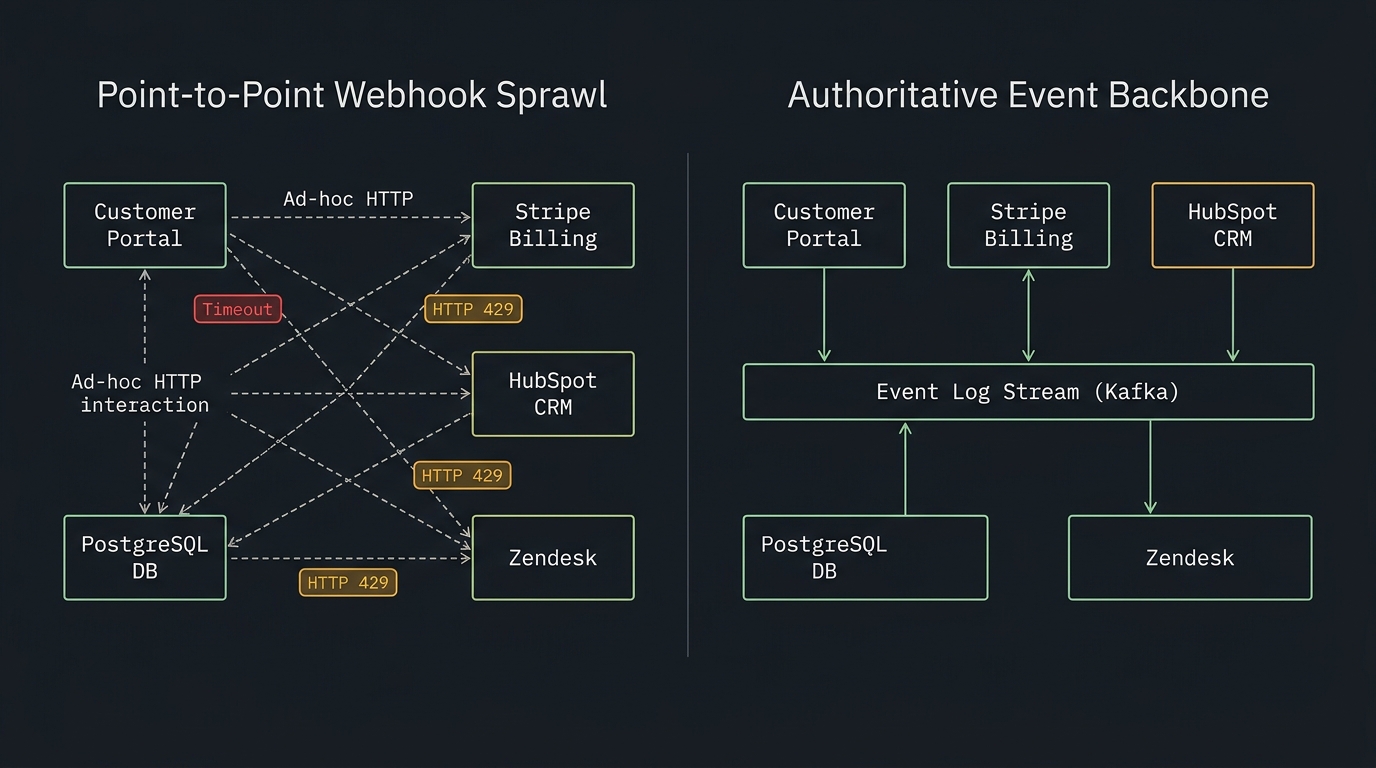
Enterprise system fragmentation occurs when independent applications (CRMs, ERPs, billing rails, databases) accumulate across departmental silos without an authoritative operational backbone. Cross-functional workflows become dependent on brittle point-to-point webhooks and manual data transfers, leading to state drift, duplicate transactions, and operational downtime.
The Illusion of the "Best-of-Breed" Stack
Over the past decade, enterprise software procurement changed completely.
In the 1990s and early 2000s, companies bought single monolithic enterprise suites like SAP or Oracle. They were cumbersome, notoriously painful to configure, and universally disliked by end users. But they had one massive technical advantage: a single database with a unified data model. When an order was updated, every department read from the same underlying tables.
Then SaaS unbundled enterprise software.
Sales teams chose Salesforce because it suited sales reps. Customer success chose Zendesk. Finance chose NetSuite. Product teams chose Mixpanel. Each department purchased whatever tool had the best UI and the lowest friction for their specific team.
The pitch was seductive: why buy a mediocre all-in-one suite when you can assemble the best tool for every job?
Here is what nobody mentioned on the sales calls: organizational charts are siloed, but business operations are continuous.
An order isn't a "sales object" or a "finance object" or an "inventory object." It is an operational state machine that travels across the entire company. When you break that state machine across six different vendor clouds, each with its own proprietary schema, rate limits, retry policies, and uptime schedules, you haven't built a modern stack. You've built a distributed system across machines you don't control, with zero global transaction boundaries.
The Mathematical Trap: Point-to-Point Connections
When teams first encounter this friction, they build point-to-point connections.
A developer writes a script to sync new CRM contacts to the email marketing tool. Another developer configures a webhook to alert Slack when a deal closes. A third sets up an iPaaS workflow (Zapier, Make, or Workato) to pass invoice statuses from Stripe to NetSuite.
It works for three systems. Then the organization adds a fourth, a fifth, and a sixth.
The math of point-to-point integration is unforgiving. If you have $N$ independent applications that need to share state, the number of potential bilateral interfaces scales quadratically:
$$\text{Connections} = \frac{N(N - 1)}{2}$$
With 4 systems, you manage 6 connections. Manageable.
With 8 systems, you manage 28 connections. Fragile.
With 15 systems—standard for a 100-person company—you manage 105 distinct integration pathways.
Every single one of those pathways introduces distinct failure vectors:
- API schema changes that break JSON payloads without warning.
- Rate limits that trigger silent data drops during peak volume.
- Unhandled network timeouts that leave transactions half-committed.
- Asynchronous race conditions where an update arrives before the record creation event.
At 100 integration pathways, your engineering team is no longer building core product. They're acting as full-time janitors for third-party API drift.
Data Transport vs. State Synchronization
Most teams treat integration as a data transport problem. They ask: "Can we send payload X from System A to System B?"
If the HTTP status returns 200 OK, they mark the ticket as resolved.
Transporting data is trivial. Synchronizing operational state across independent databases is one of the hardest problems in computer science.
Consider a simple operational event: a customer cancels an annual contract.
- The CRM marks the account status as
Churned. - A webhook fires to the billing platform to cancel recurring subscriptions at period end.
- A second webhook fires to the application database to revoke user seat access.
- An event fires to data warehousing to record customer churn for financial reporting.
What happens if step 3 succeeds, but step 2 fails due to a gateway timeout on the payment processor?
The customer can no longer log in, but their credit card is charged again next Monday. The customer files a chargeback, support panics, and engineering spends hours running manual database queries across three systems to reconstruct what happened.
Point-to-point integrations have no two-phase commits. They have no distributed transaction manager. They have no native rollback mechanism. Once you pass step 1, any downstream failure leaves your organization in a split-brain state where different departments operate on contradictory versions of reality.
Why iPaaS and No-Code Band-Aids Make It Worse
When engineering teams get overwhelmed by integration maintenance, companies often buy enterprise iPaaS platforms.
The promise is alluring: drag-and-drop workflow builders that allow non-technical teams or operations managers to connect tools without filing engineering tickets.
In practice, this frequently accelerates architectural decay.
When you allow individual departments to configure automated branching logic inside a third-party UI, you extract business logic from code repositories and bury it in graphical interfaces that cannot be version-controlled, unit-tested, or monitored with standard engineering observability tools.
No-code automations obscure dependencies. When a database migration renames a column six months later, no compiler warns you that a critical Zapier workflow three departments over just stopped syncing customer records.
The failure happens silently. The company discovers it three weeks later during month-end reconciliation.
The Structural Exit: Event-Driven Core Topology
You cannot solve systemic fragmentation by adding more point-to-point glue or more visual workflow widgets. You solve it by changing the system topology.
Instead of allowing every tool to talk directly to every other tool, high-reliability engineering organizations decouple applications through an authoritative operational backbone.
This structural shift requires three concrete engineering principles:
1. Invert the Communication Pattern
Applications should not push data directly to downstream systems. Applications should publish domain events ("OrderPlaced", "AddressChanged", "SubscriptionCanceled") to an authoritative ingestion gateway.
Downstream consumers subscribe to the stream and update their own state independently. If the billing system is down for maintenance, events queue safely in durable storage rather than disappearing into the ether.
2. Enforce Strict Schemas at the Boundary
Never allow raw, unvalidated JSON to travel across systems. Define explicit schema contracts using Protocol Buffers, JSON Schema, or strongly-typed event interfaces.
If a system attempts to publish an event that violates the contract, reject it at the gateway with an immediate diagnostic error. Catching invalid payloads at ingestion prevents silent corruption across ten downstream tools.
3. Establish Canonical State Ownership
For every core operational entity—Customer, Order, Payment, Inventory—designate exactly one authoritative system of record.
If the internal database owns customer state, no third-party CRM is permitted to overwrite customer records directly. The CRM submits a change request; the authoritative system validates the business rules, commits the change, and broadcasts the verified event.
Building Systems That Scale With You
Fragmentation is not an inevitable tax on growth. It is the natural consequence of letting software procurement outpace systems architecture.
When you treat integration as an ad-hoc plumbing task, your operational debt compounds with every hire and every new software subscription. When you treat integration as a core architectural discipline—grounded in decoupled event streams, enforced schemas, and sovereign state boundaries—your systems remain resilient regardless of how large the organization becomes.
Before attempting to reconnect brittle tools, engineering teams must map canonical state lifecycles and evaluate operational system boundaries. And when dealing with entrenched monoliths, avoid the trap of high-risk total rewrites by learning how to modernize legacy systems without rebuilding everything.
Engineering Operational Reliability
If your team is struggling with brittle point-to-point integrations, data drift between platforms, or workflows that break under scale, you don't need another generic SaaS tool. You need deployable systems architecture.
At Pluggedspace, we design sovereign platforms and deploy Forward Deployed Engineering teams to eliminate operational fragmentation for complex, mission-critical systems.
Discuss your system boundaries and operational challenges with our engineering team →