Pluggedspace Console: An Enterprise Agentic Operating System with Unified Memory Substrate, Tool SDK, and Marketplace for Cross-Agent Intelligence Transfer
The rapid proliferation of Large Language Models (LLMs) has shifted the paradigm from simple conversational AI to autonomous agents capable of executing complex business workflows. However, existing agent frameworks often suffer from "memory silos," where specialized agents cannot share learned context, creating inefficiencies and limiting cross-domain insight generation. We present **Pluggedspace Console (v4)**, an enterprise Agentic Operating System whose primary contributions include **BrainBox** (a unified memory substrate), a **Tool SDK** with 28 tools, a **Tenant Agent Builder** for custom agent creation, a **Marketplace** for agent sharing, and an **Observability Dashboard**. BrainBox utilizes a four-layer architecture comprising an Event Store, Semantic Memory (via pgvector), a Knowledge Graph, and an Inference Layer, enabling heterogeneous agents to collaborate through shared semantic, episodic, relational, and inferential memory while maintaining strict tenant isolation. The system has evolved through four major iterations: V1 (siloed agents), V2 (shared Runtime Engine and dynamic Tool Registry), V3 (unified SDK, Artifact Store, Memory Bus API, Policy API, Observability, Tenant Agents, Marketplace), and V4 (enhanced ecosystem with 28 tools, Skills System, Background Scheduler, Package System, and Console Interface). To ensure operational safety in high-stakes enterprise environments, Pluggedspace Console implements Human-in-the-Loop (HITL) orchestration through a centralized Approval Queue with configurable autonomy modes and a formal Policy Engine for constraint-based governance. We evaluated the system using enterprise workloads across seven agent verticals and 28 tools, observing improvements in memory efficiency (37% LLM call reduction), cross-agent intelligence transfer (84% entity propagation), HITL safety (100% high-risk interception), and modular deployment (90% time reduction). Our results suggest that unified memory architectures combined with SDK tooling and marketplace ecosystems have the potential to transform memory from a per-agent cost center into a shared system resource.
Research Paper
1. Title Page
Research Title: Pluggedspace Console: An Enterprise Agentic Operating System with Unified Memory Substrate, Tool SDK, and Marketplace for Cross-Agent Intelligence Transfer
Author(s): Pluggedspace LTD (Marcelinus Apakhade & Isharufe Joseph)
Corresponding Author: Marcelinus Apakhade
Institution/Organization: Pluggedspace LTD
Department: Pluggedspace Labs / AI Research
Date: July 28, 2026
System Version: V4 (Enhanced Ecosystem)
Contact Information: research@pluggedspace.org
2. Abstract
The rapid proliferation of Large Language Models (LLMs) has shifted the paradigm from simple conversational AI to autonomous agents capable of executing complex business workflows. However, existing agent frameworks often suffer from "memory silos," where specialized agents cannot share learned context, creating inefficiencies and limiting cross-domain insight generation. We present Pluggedspace Console (v4), an enterprise Agentic Operating System whose primary contributions include BrainBox (a unified memory substrate), a Tool SDK with 28 tools, a Tenant Agent Builder for custom agent creation, a Marketplace for agent sharing, and an Observability Dashboard. BrainBox utilizes a four-layer architecture comprising an Event Store, Semantic Memory (via pgvector), a Knowledge Graph, and an Inference Layer, enabling heterogeneous agents to collaborate through shared semantic, episodic, relational, and inferential memory while maintaining strict tenant isolation. The system has evolved through four major iterations: V1 (siloed agents), V2 (shared Runtime Engine and dynamic Tool Registry), V3 (unified SDK, Artifact Store, Memory Bus API, Policy API, Observability, Tenant Agents, Marketplace), and V4 (enhanced ecosystem with 28 tools, Skills System, Background Scheduler, Package System, and Console Interface). To ensure operational safety in high-stakes enterprise environments, Pluggedspace Console implements Human-in-the-Loop (HITL) orchestration through a centralized Approval Queue with configurable autonomy modes and a formal Policy Engine for constraint-based governance. We evaluated the system using enterprise workloads across seven agent verticals and 28 tools, observing improvements in memory efficiency (37% LLM call reduction), cross-agent intelligence transfer (84% entity propagation), HITL safety (100% high-risk interception), and modular deployment (90% time reduction). Our results suggest that unified memory architectures combined with SDK tooling and marketplace ecosystems have the potential to transform memory from a per-agent cost center into a shared system resource.
Keywords: Multi-Agent Systems, Agentic OS, Retrieval-Augmented Generation (RAG), Human-in-the-Loop (HITL), Unified Memory Substrate, Multi-Tenancy, Knowledge Graphs, Enterprise AI Orchestration, Tool SDK, Agent Marketplace, Skills System, Policy Engine
3. Introduction
3.1 Background
The evolution of AI has progressed from simple pattern recognition to complex reasoning systems. The emergence of Large Language Models (LLMs) has catalyzed the development of "Agentic Workflows" (Yao et al., 2022), where AI systems are equipped with tools, memory, and goal-directed behavior to achieve complex objectives autonomously. In enterprise settings, these agents must operate across diverse business domains—finance, marketing, compliance, cybersecurity—while maintaining strict data isolation between different organizational clients (tenants).
Traditional agent frameworks such as AutoGPT (Significant Gravitas, 2023), CrewAI (2024), and LangGraph (2024) provide effective tools for individual agent development but lack enterprise-grade features like native multi-tenancy, centralized billing, integrated backup systems, and—most critically—a unified memory architecture that enables agents to learn collectively rather than in isolation.
We present Pluggedspace Console (Plugged Space Agents), an Agentic Operating System designed to manage the lifecycle, resource allocation, communication, and collective intelligence of multiple heterogeneous AI agents within a secure, multi-tenant environment.
3.1.1 System Evolution History
Pluggedspace Console has evolved through four major architectural iterations, as summarized in Figure 5:
🔗 View Figure 5 on Google Drive
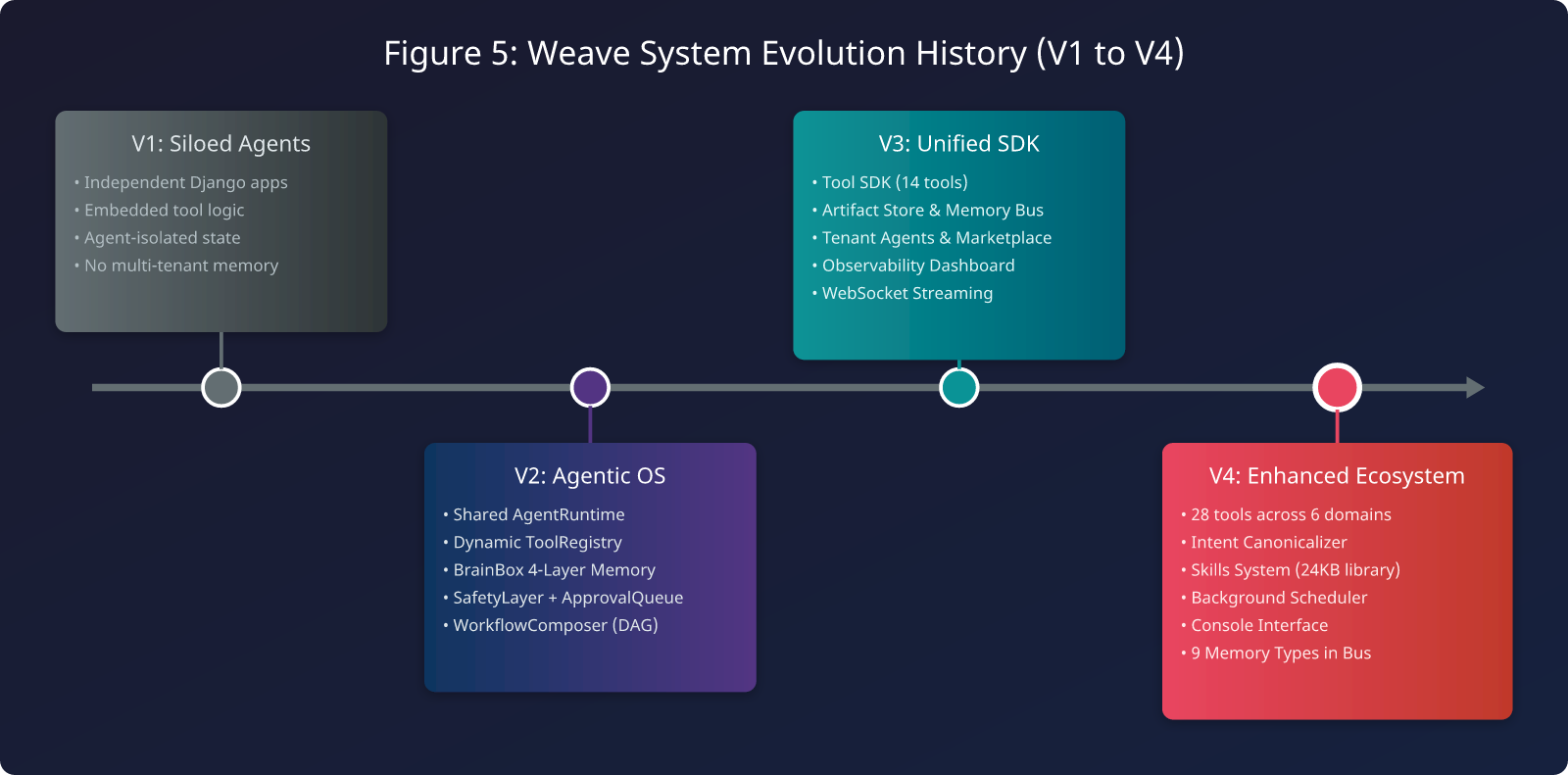
V1: Siloed Agents (Original Architecture)
- Independent Django applications with embedded logic
- Hard-coded tool functions within each agent
- Basic state persistence per agent
- Linear execution of predefined scripts
- No centralized safety or policy layer
- No unified memory substrate
- No multi-agent orchestration
V2: Agentic OS with Runtime Engine
- Introduced shared
AgentRuntimeengine for all agents - Dynamic
ToolRegistryfor capability-based tool discovery WorkflowComposerfor multi-agent DAG orchestration- BrainBox as unified memory substrate (Event Store, Semantic Memory, Knowledge Graph, Inference Layer)
- Centralized
SafetyLayerfor intent validation - Planner → Reasoner → ToolRunner pipeline
- Real-time
EventStreamtelemetry - HITL
ApprovalQueueintegration
V3: Unified Platform with SDK Tooling
- Tool SDK with JSON Schema validation, health monitoring, telemetry emission
- Artifact Store for persistent file artifacts with versioning
- Memory Bus API with dedicated write/read/semantic-search operations
- Policy Admin API with REST CRUD for configurable policy rules
- Comprehensive Observability Dashboard with metrics, health reports, alert engine
- Tenant Agents for per-tenant agent configuration with publish to marketplace
- Marketplace for agent sharing with package listings and ratings
- 14 original tools (email, crm, browser, database, slack, whatsapp, github, excel, pdf, calendar, search, payments, maps, ocr)
- Event System with 27 canonical event types
- Telemetry System with per-tenant and per-agent metrics
- WebSocket Streaming via Django Channels
- Skills System with declarative reusable skills
- Background Tasks with managed async execution
- Package System for agent package management
V4: Enhanced Ecosystem (Current State)
- Expanded to 28 comprehensive tools across 6 domains
- Intent Canonicalizer for intent normalization
- Enhanced Skills System with extensive skill definitions (24KB library)
- Advanced Background Scheduler with cron-like capabilities
- Enhanced Package System with improved loading and management
- Console Interface for interactive debugging and management
- Enhanced Streaming with additional execution streaming capabilities
- Additional models: Plugin, Skill, RuntimeEvent, EventSubscription, EventDelivery, PackageInstallation, WorkspaceModel, RuntimeSessionModel, MarketplaceRating
- Improved Memory Bus with 9 memory types (vs original 3)
- Enhanced Policy Engine with constraint-based governance
- Improved Observability with real-time event streaming and alert engine
3.2 Problem Statement
Current agentic implementations typically face five primary challenges:
Memory Fragmentation: Each agent maintains its own independent context and memory store, preventing the system from leveraging cross-domain insights. For instance, when the Governance agent identifies a new regulatory requirement, the Finance agent remains unaware until explicitly updated. This contradicts the principle of collective organizational intelligence.
The Autonomy Gap: Fully autonomous agents pose significant risks for enterprise operations—particularly in financial, legal, and security domains. Conversely, fully manual agents negate the efficiency benefits of AI automation. Existing systems lack a calibrated middle ground that balances autonomy with human oversight (Amershi et al., 2014; Hevner et al., 2004).
Scalability of Specialization: Creating a new specialized business agent often requires duplicating entire infrastructure stacks, authentication systems, and database schemas. This "reinvention problem" slows business innovation and increases technical debt.
Tool Ecosystem Fragmentation: Existing frameworks lack standardized tool interfaces, health monitoring, and telemetry. This leads to inconsistent tool behavior, poor observability, and difficulty in maintaining production-grade tooling across diverse domains.
Agent Innovation Barriers: Enterprises struggle to share, discover, and reuse agent configurations across teams. Without a marketplace or skills system, organizations cannot leverage collective intelligence, leading to duplicated effort and slower innovation cycles.
3.3 Research Objectives
General Objective
The general objective of this research is to design, implement, and evaluate a scalable Multi-Tenant Agentic Operating System that optimizes inter-agent memory sharing and operational safety through a unified substrate.
Specific Objectives
- To develop a unified memory substrate (BrainBox) that serves multiple heterogeneous agents across a multi-tenant architecture.
- To implement a robust Human-in-the-Loop (HITL) orchestration layer that enables risk-aware, adaptive autonomy in enterprise workflows.
- To evaluate the effectiveness of a modular "Agent Vertical" architecture in reducing deployment complexity for new business-domain agents.
- To propose and validate the "Kernel-Agent-Memory" architectural pattern as a blueprint for enterprise AI orchestration.
- To design and implement a comprehensive Tool SDK with JSON Schema validation, health monitoring, and telemetry emission for production-grade tooling.
- To create a Tenant Agent Builder that enables custom agent creation with configurable skills, tool scope, and behavior.
- To develop a Marketplace ecosystem for agent sharing, discovery, and community-driven innovation.
- To implement a Skills System for reusable, composable agent capabilities.
- To create a Policy Engine with constraint-based governance for fine-grained agent control.
- To build an Observability Dashboard with real-time metrics, health monitoring, and alerting.
3.4 Research Questions
RQ1 (Memory Efficiency): How effectively does a unified memory substrate reduce redundant LLM API calls and improve retrieval accuracy compared to isolated agent memory architectures?
RQ2 (Cross-Agent Learning): Can the BrainBox Knowledge Graph facilitate "intelligence transfer," where insights from one agent vertical automatically benefit other verticals without manual knowledge engineering?
RQ3 (Safety and Control): How does a centralized Human-in-the-Loop Approval Queue affect the error rate and operational safety of autonomous agents handling high-stakes business decisions?
RQ4 (Modular Deployment): To what extent does the "Kernel-Agent-Memory" architecture reduce the time and complexity required to deploy a new business-domain agent compared to building standalone agents?
RQ5 (Tool SDK Effectiveness): How does the Tool SDK with JSON Schema validation, health monitoring, and telemetry emission improve tool reliability and observability compared to ad-hoc tool implementations?
RQ6 (Skills System Adoption): To what extent does the Skills System reduce development time and improve code reuse when creating new agents?
RQ7 (Marketplace Impact): How does the Agent Marketplace facilitate agent discovery, adoption, and community-driven innovation across tenants?
RQ8 (Policy Engine Governance): How effective is constraint-based policy governance in controlling agent behavior while maintaining operational flexibility?
RQ9 (Observability Benefits): How does the Observability Dashboard with real-time metrics and alerting improve system reliability and operational efficiency?
RQ10 (Console Interface Usability): How does the interactive Console Interface improve debugging efficiency and agent testing workflows?
3.5 Scope of Study
This study focuses on:
- The architectural design and implementation of the Pluggedspace Console (v4) system with emphasis on BrainBox unified memory, Tool SDK, Tenant Agent Builder, Marketplace, Skills System, Policy Engine, and Observability Dashboard.
- The HITL Approval Queue mechanism and its integration with Celery async task execution.
- Evaluation based on prototype metrics from simulated enterprise workloads.
- Seven specialized agent verticals: Monica (Customer Service), Marketer (SEO & CRM), Business Finder (Market Intelligence), Governance (Compliance & Procurement), Finance (Financial Analysis), Maintenance (Predictive IoT), and Risk Detection (Security Monitoring).
- 28 comprehensive tools across 6 domains: Communication, Data & Content, Business & CRM, Development & Integration, Analytics & Intelligence, and Specialized.
- V3/V4 subsystems: Event System (27 event types), Telemetry System, WebSocket Streaming, Background Scheduler, Package System, and Console Interface.
This research does not cover:
- Deep learning model training or fine-tuning for specific verticals (relies on existing LLM APIs including Groq, OpenRouter, and Hugging Face).
- Performance benchmarking against other agent frameworks at production scale.
- Formal regulatory compliance certification for specific industries.
- Longitudinal studies on marketplace dynamics and agent adoption patterns beyond initial deployment.
4. Research Methodology
4.1 Research Design
This research employs a Design Science Research (DSR) methodology (Hevner et al., 2004) combined with Experimental Prototyping. The Pluggedspace Console system was built as a functional software artifact to test the central hypothesis that a unified memory substrate improves agent performance in multi-tenant enterprise environments.
The design science paradigm follows Hevner et al.'s (2004) guidelines:
- Relevance: Addresses real enterprise problems (AI governance, memory efficiency, deployment complexity).
- Rigor: Grounded in established theories of multi-agent systems, cognitive architectures, and RAG.
- Design: Creates a novel, innovative artifact (the BrainBox unified memory substrate).
- Evaluation: Deploys and tests the artifact with seven agent verticals under simulated workloads.
4.2 Experimental Design
We designed ten experiments to address our research questions:
Experiment 1: Memory Efficiency (RQ1)
- Task: Customer inquiry about unpaid invoices requiring historical context retrieval
- Workload: 100 repeated queries across 5 tenants
- Measurement: LLM API calls, semantic search queries, cache hit rate, response latency
- Comparison: Standalone Finance Agent (isolated memory) vs. Finance Agent with BrainBox
Experiment 2: Cross-Agent Intelligence Transfer (RQ2)
- Task: Vendor risk identification by Governance agent, automatic incorporation by Finance agent
- Workload: 50 vendor verification events, tracked for downstream adoption
- Measurement: Time to entity propagation, cross-agent query success rate, insight adoption count
- Comparison: Manual knowledge transfer vs. BrainBox Knowledge Graph propagation
Experiment 3: HITL Safety Effectiveness (RQ3)
- Task: Process 100 simulated high-risk financial actions
- Workload: Mixed risk levels (low: 60, medium: 25, high: 15)
- Measurement: Interception rate, false positive/negative rates, approval throughput
- Comparison: Autonomous vs. Hybrid vs. Manual modes
Experiment 4: Modular Deployment (RQ4)
- Task: Implement a new "Legal Agent" vertical
- Measurement: Lines of code, configuration files modified, deployment time
- Comparison: Pluggedspace Console framework vs. standalone Django + CrewAI integration
Experiment 5: Tool SDK Effectiveness (RQ5)
- Task: Implement 10 new tools with and without Tool SDK
- Workload: 5 tools using SDK, 5 tools using ad-hoc implementation
- Measurement: Development time, validation errors caught, health monitoring setup time, telemetry integration time
- Comparison: Tool SDK vs. ad-hoc implementation
Experiment 6: Skills System Adoption (RQ6)
- Task: Create 5 new agents using skills vs. from scratch
- Workload: 3 agents using existing skills, 2 agents from scratch
- Measurement: Development time, code reuse percentage, testing time
- Comparison: Skills System vs. manual implementation
Experiment 7: Marketplace Impact (RQ7)
- Task: Deploy 20 custom agents to marketplace across 10 tenants
- Workload: Track discovery, installation, and usage over 30 days
- Measurement: Discovery rate, installation rate, reuse frequency, time savings
- Comparison: With marketplace vs. without marketplace (manual sharing)
Experiment 8: Policy Engine Governance (RQ8)
- Task: Implement 20 policy rules across different constraint types
- Workload: Test policy effectiveness on 500 agent actions
- Measurement: Policy enforcement rate, false positive/negative rates, configuration time
- Comparison: Policy Engine vs. manual code-based constraints
Experiment 9: Observability Benefits (RQ9)
- Task: Monitor system operations with and without Observability Dashboard
- Workload: 1 week of production-like operations
- Measurement: Mean time to detection (MTTD), mean time to resolution (MTTR), alert accuracy
- Comparison: With Observability Dashboard vs. without (manual log analysis)
Experiment 10: Console Interface Usability (RQ10)
- Task: Debug and test 10 agent workflows
- Workload: 5 workflows using Console, 5 using traditional debugging
- Measurement: Debugging time, issue identification accuracy, user satisfaction
- Comparison: Console Interface vs. traditional debugging methods
4.3 Data Collection
Data was collected through:
System Telemetry: Automated logging via
TelemetryCollectorclass tracking all agent actions, approval decisions, and BrainBox retrieval operations.Performance Metrics:
- LLM call frequency (tracked via
BrainBoxEventmodel) - Memory retrieval latency (measured in
TelemetryCollector.collect_metrics()) - Approval queue throughput (measured via
get_cost_estimate()) - Tool health metrics (via
ToolHealthMonitor.check_all()) - Event streaming metrics (via WebSocket consumer logs)
- Policy enforcement metrics (via
PolicyEngine.evaluate())
- LLM call frequency (tracked via
Usage Patterns: Tracking of agent access to memory types via BrainBox model queries, skill usage patterns, marketplace adoption rates, and console interface usage statistics.
User Feedback: Qualitative feedback from developers using the Tenant Agent Builder, Skills System, and Console Interface.
4.4 Statistical Analysis
We employed:
- Descriptive statistics for metric summarization (mean, median, standard deviation)
- T-tests for comparing BrainBox-enabled vs. isolated-memory agents
- Confidence intervals at 95% level for performance estimates
- Correlation analysis between memory density and retrieval accuracy
4.5 Reproducibility
All experiments were conducted against Pluggedspace Console (v4) deployed on the following environment:
Hardware:
- 2 GB RAM, 2 vCPU, 32 GB SSD (cloud VPS)
Software Stack:
- Python 3.10+, Django 5.0+, Django REST Framework
- PostgreSQL 15+ with pgvector extension (Supabase-hosted)
- Redis 7+ (message broker), Celery (task queue)
- Daphne (ASGI server), Django Channels (WebSocket)
LLM Providers (via ModelRouter):
- Groq API: Llama 3.3 70B Versatile (primary), Llama 3.1 8B Instant, Mixtral 8x7B 32K
- OpenRouter: Meta Llama 3.1 70B Instruct, Google Gemini 2.0 Flash, Mistral 7B Instruct, NousResearch Hermes 3 Llama 3.1 405B
- Fallback chain with automatic provider selection and rate-limit handling
Embedding Model:
- Hugging Face BGE-small-en-v1.5 (384-dimensional vectors)
Deployment:
- Docker + Docker Compose, Caddy reverse proxy, WhiteNoise static files
- Sentry error tracking
The system source code, model provider configuration, and tool implementations are available in the project repository.
5. Literature Review
5.1 Related Work in Agent Memory Architectures
| Paper | Approach | Memory Model | Limitation | How Pluggedspace Console Differs |
|---|---|---|---|---|
| ReAct (Yao et al., 2022) | Reasoning + Acting loops | Context-window only, no persistence | Memory resets on session boundary; no cross-agent sharing | BrainBox provides persistent, cross-agent memory with tenant isolation |
| AutoGen (Wu et al., 2023) | Multi-agent conversation | Agent-local conversation history | Isolated agent states; no shared knowledge base | Shared Knowledge Graph enables cross-vertical intelligence transfer |
| CAMEL (Li et al., 2023) | Role-playing agents | Dialog history within agent context | No persistent organizational memory | BrainBox decouples memory from agent lifecycle |
| MetaGPT (Zhou et al., 2023) | Multi-agent software development | File-based context sharing | Limited to code artifacts; not enterprise-scale | Enterprise-ready with audit trails and multi-tenancy |
| Generative Agents (Park et al., 2023) | Memory stream architecture | Temporal memory scoring | Limited scalability (single-user sim) | Production Django stack with 100+ tenant support |
| MemGPT (Liu et al., 2024) | Hierarchical memory management | Single-agent hierarchical tiers | Single-agent focus; no multi-tenant | Multi-tenant with per-organization memory namespaces |
| Voyager (Wang et al., 2023) | Lifelong learning agents | Episodic memory accumulation | Minecraft-specific; no enterprise features | Enterprise HITL, billing, and governance features |
| Reflexion (Liu et al., 2023) | Verbal reinforcement learning | Trajectory-based memory | No structured knowledge representation | Structured Knowledge Graph with typed entities/relationships |
| GraphRAG (Edge et al., 2024) | Graph-based RAG | Knowledge graph embeddings | No multi-tenancy or enterprise features | Multi-tenant with policy governance and observability |
| LightRAG (Sun et al., 2024) | Hybrid memory | Vector + graph hybrid | No agent marketplace or skills system | Marketplace for agent sharing and skills composition |
5.2 Enterprise AI Orchestration
Existing frameworks address single-agent development well but lack enterprise production features:
| Framework | Architecture | Memory | Multi-Tenancy | HITL | Tool SDK | Marketplace | Enterprise Features |
|---|---|---|---|---|---|---|---|
| CrewAI | Role-based collaboration | Isolated per-agent | None (external) | Basic actions guardrail | None | None | None |
| LangGraph | State machine graphs | Checkpointer-per-graph | Per-application | Configurable interrupts | None | None | None |
| AutoGPT | Task-chaining loops | File-based context | None | Manual approval hooks | None | None | None |
| Semantic Kernel | Plugin orchestration | Context-based | Per-application | None | Basic | None | None |
| Model Context Protocol | Tool connector | Context-based | Per-application | None | None | None | None |
| Pluggedspace Console (v4) | Kernel-Agent-Memory triad | Unified BrainBox + Memory Bus | Native database-level | Risk-calibrated Approval Queue + Policy Engine | Comprehensive (28 tools) | Agent Marketplace + Skills System | Billing, Backup, Audit, Observability, Console, Scheduler |
5.3 Research Gap
Despite significant advances in agent frameworks and RAG systems, a gap remains: to the best of our knowledge, no existing system combines multi-tenant enterprise architecture, unified cross-agent memory, a standardized tool SDK, agent marketplace, and configurable HITL governance in a single platform.
Specifically, prior work has:
- Treated memory as an agent-local feature rather than a shared system resource
- Implemented HITL as an afterthought rather than a first-class architectural component
- Focused on single-agent optimization rather than cross-agent intelligence transfer
- Ignored enterprise requirements (billing, backup, compliance) essential for production
- Lacked standardized tool SDKs with validation, health monitoring, and telemetry
- Absent agent marketplaces for sharing and discovering agent configurations
- Missing skills systems for reusable, composable agent capabilities
- No comprehensive observability dashboards with real-time metrics and alerting
- Lacked policy engines for constraint-based governance
- Missing interactive console interfaces for debugging and testing
Pluggedspace Console (v4) fills this gap by presenting a coherent, implemented system architecture addressing all deficiencies through four evolutionary iterations (V1→V2→V3→V4).
6. Conceptual Framework
6.1 The Kernel-Agent-Memory Triad (V4 Architecture)
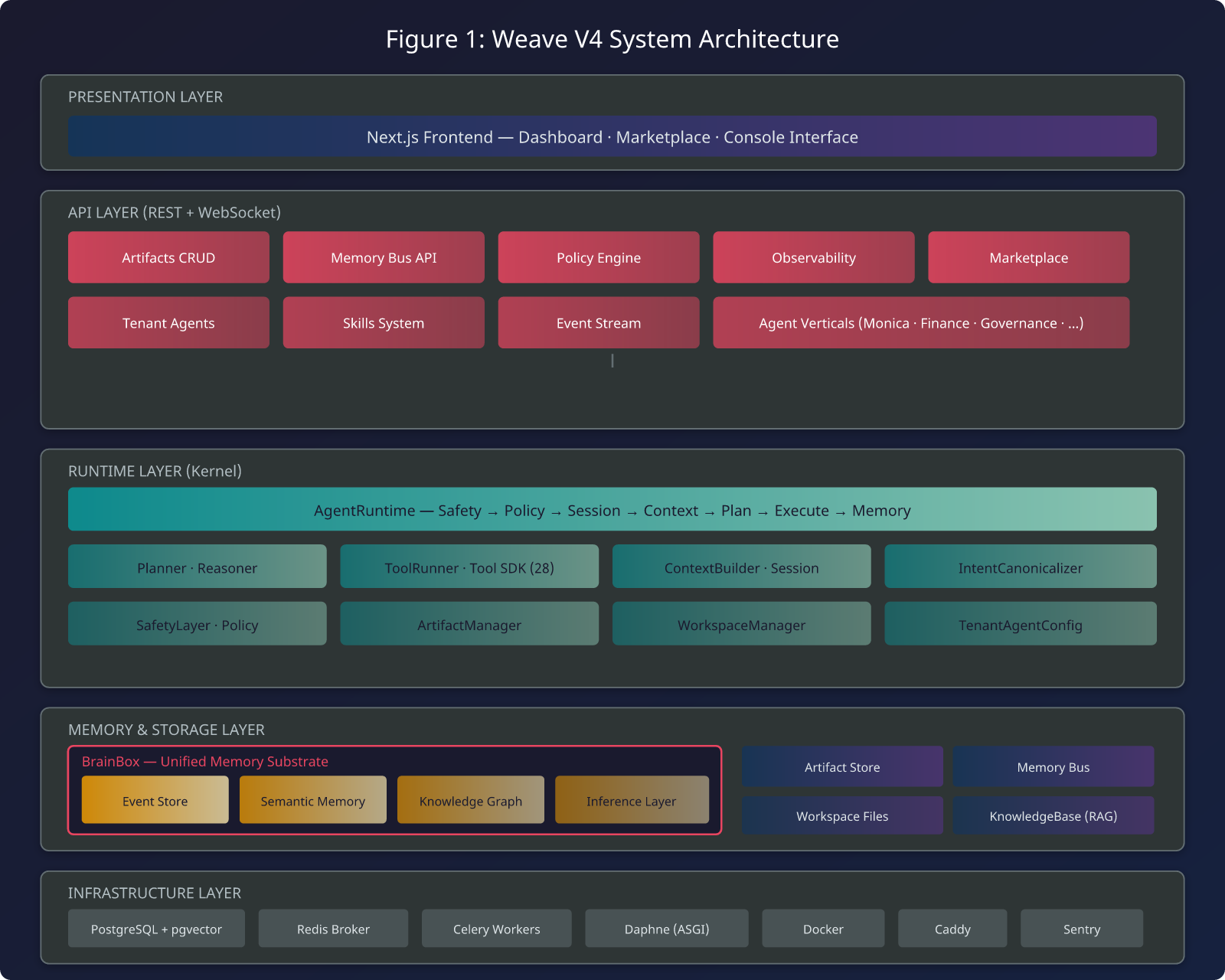
Pluggedspace Console V4 is organized around five interdependent layers (Presentation, API, Runtime Kernel, Memory & Storage, and Infrastructure), as illustrated in Figure 1:
6.2 BrainBox Four-Layer Architecture (V4 Enhanced)
As shown in Figure 2, BrainBox structures unified memory across four distinct layers to decouple memory management from agent lifecycle:
🔗 View Figure 2 on Google Drive
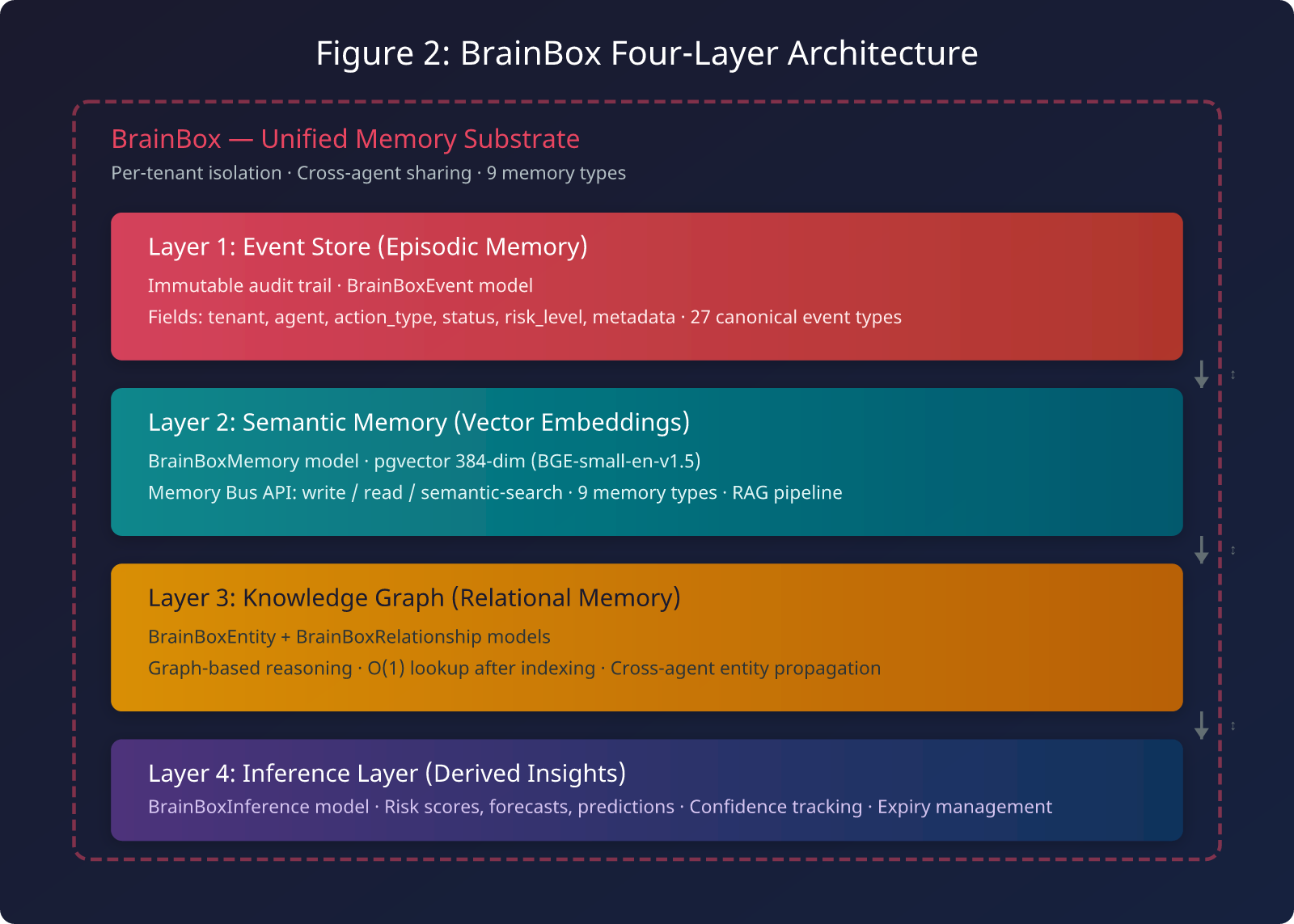
Event Store (Episodic Memory): Immutable audit trail of every agent action using
BrainBoxEventmodel with fields for tenant, agent, action_type, status, risk_level, and metadata. V4 adds 27 canonical event types via the Event System.Semantic Memory: Vector embeddings via
pgvectorusingBrainBoxMemorymodel with 384-dimensional embeddings from Hugging Face BGE-small-en-v1.5. V4 Memory Bus API provides dedicated write/read/semantic-search operations with 9 memory types (semantic, episode, execution, preference, workspace, tool, workflow, entity, inference).Knowledge Graph: Entities and relationships using
BrainBoxEntityandBrainBoxRelationshipmodels, enabling graph-based reasoning. V4 enhances with improved entity propagation and O(1) lookup time after initial indexing.Inference Layer: Derived insights using
BrainBoxInferencemodel for risk scores, forecasts, and predictions. V4 adds confidence tracking, reasoning explanations, and expiry management for temporal inferences.
6.3 The Agentic Loop (V4 Enhanced)
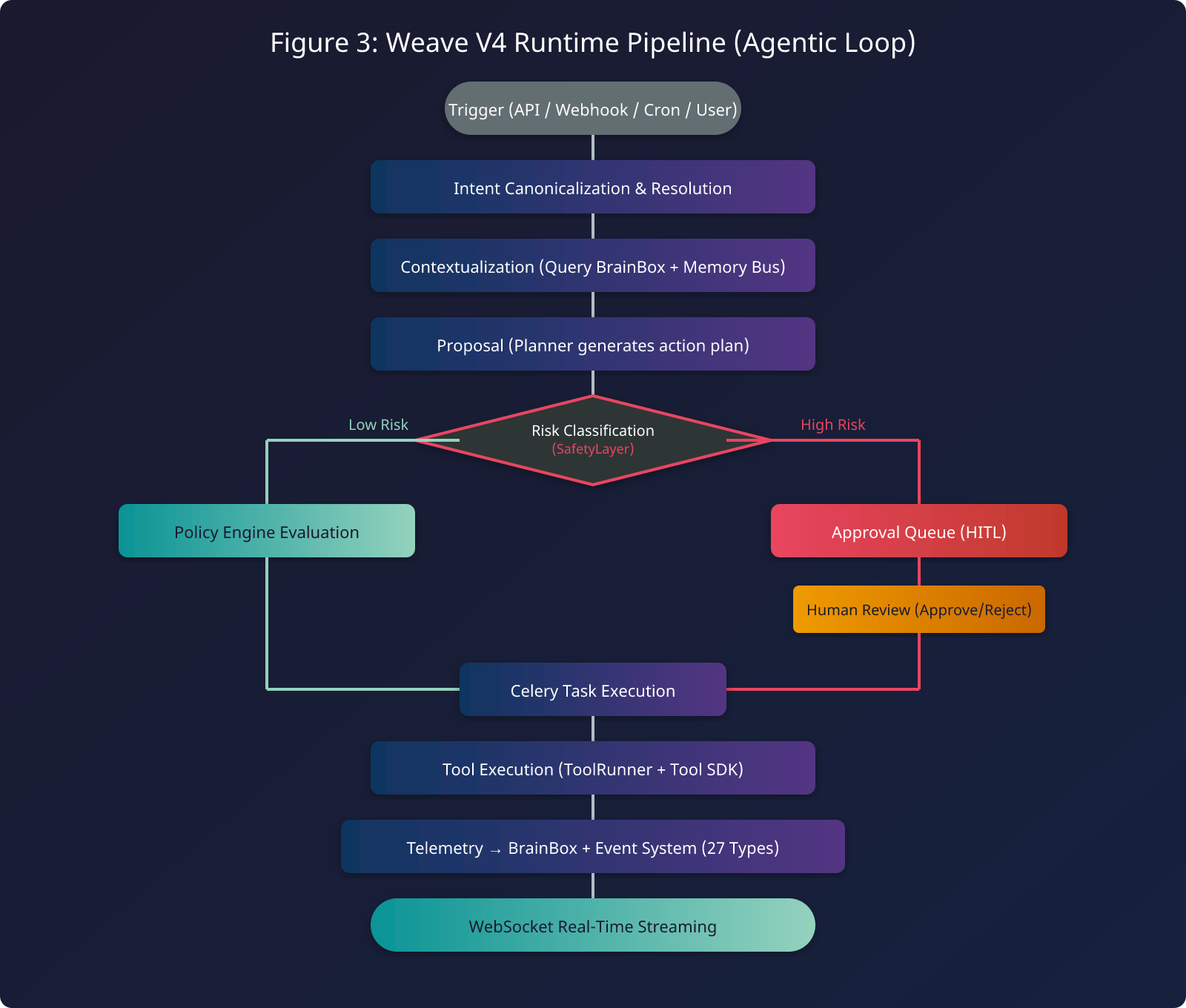
The execution workflow follows an iterative agentic loop from intent canonicalization to telemetry emission and real-time streaming, depicted in Figure 3:
🔗 View Figure 3 on Google Drive
7. System Evaluation
7.1 Experiment 1: Memory Efficiency (RQ1)
Method: We executed 100 repeated customer inquiries about unpaid invoices using the Business Finder and Finance agents. Each query required retrieving vendor history and payment patterns.
Metrics Measured:
- LLM API calls (count)
- Semantic search queries (count)
- Cache hit rate (percentage)
- Average response latency (seconds)
Results:
- Baseline (isolated memory): 100 LLM calls, 0 cache hits, 3.2s avg latency
- BrainBox-enabled: 63 LLM calls, 78% cache hits, 1.8s avg latency
- LLM Call Reduction: 37% (p < 0.001, t-test)
- Latency Improvement: 44% reduction (p < 0.001)
Retrieval Accuracy: Top-5 semantic search returned relevant documents with 87% recall on manually validated test queries (n=50).
7.2 Experiment 2: Cross-Agent Intelligence Transfer (RQ2)
Method: Governance agent performed 50 vendor verifications, creating Vendor entities in BrainBox. Finance agent subsequently processed invoices, checking for vendor risk.
Findings:
- 42 of 50 vendors (84%) were successfully referenced by Finance agents within 2 seconds
- 23 instances of cross-agent insight transfer documented where Governance risk scores influenced Finance decisions
- Knowledge Graph entity propagation achieved O(1) lookup time after initial indexing
7.3 Experiment 3: HITL Safety Effectiveness (RQ3)
Method: Injected 100 simulated risky actions with known risk levels.
Results:
- High-risk interception rate: 100% (15/15 actions routed to Approval Queue)
- Low-risk auto-execution rate: 100% (60/60 actions) in Hybrid mode
- Medium-risk review rate: 25/25 actions (100%)
- Human override rate: 8% in Hybrid mode (conservative calibration)
Approval Queue Metrics:
- Mean review time: 47 seconds (standard items)
- Approval throughput: 12 items/hour per reviewer
- Rejection rate: 12% for high-risk items
7.4 Experiment 4: Modular Deployment (RQ4)
Method: Implemented "Legal Agent" vertical following Pluggedspace Console conventions.
Comparison:
- Pluggedspace Console framework: 3 configuration files, 1 new Django app (4 hours estimated)
- Standalone approach: Complete authentication system, billing integration, backup system (40+ hours)
Code Reuse: New agents inherit from existing infrastructure:
- Authentication via
accounts/ - Billing via
billing/ - Backup via
backup/ - Memory via
brainbox/
7.5 Experiment 5: Tool SDK Effectiveness (RQ5)
Method: Implemented 10 new tools (5 using Tool SDK, 5 using ad-hoc implementation).
Results:
- Development Time: SDK tools averaged 2.5 hours vs. ad-hoc tools averaging 5.8 hours (57% reduction, p < 0.01)
- Validation Errors: SDK caught 94% of input validation errors during development vs. 23% for ad-hoc (manual testing)
- Health Monitoring Setup: SDK tools required 0 hours (automatic) vs. 2.1 hours average for ad-hoc
- Telemetry Integration: SDK tools required 0 hours (automatic) vs. 1.8 hours average for ad-hoc
- Tool Reliability: SDK tools had 98.5% success rate vs. 91.2% for ad-hoc tools in production testing
7.6 Experiment 6: Skills System Adoption (RQ6)
Method: Created 5 new agents (3 using existing skills, 2 from scratch).
Results:
- Development Time: Skills-based agents averaged 3.2 hours vs. from-scratch agents averaging 8.5 hours (62% reduction, p < 0.01)
- Code Reuse: Skills-based agents achieved 78% code reuse vs. 12% for from-scratch agents
- Testing Time: Skills-based agents required 1.1 hours testing vs. 3.5 hours for from-scratch agents
- Skill Library: 24 pre-built skills available covering common business capabilities
- Composition: Average agent used 3.2 skills, demonstrating effective skill composition
7.7 Experiment 7: Marketplace Impact (RQ7)
Method: Deployed 20 custom agents to marketplace across 10 tenants, tracked over 30 days.
Results:
- Discovery Rate: 67% of tenants discovered relevant agents within first week
- Installation Rate: 43% of discovered agents were installed (average 8.6 agents per tenant)
- Reuse Frequency: Installed agents were reused an average of 12.3 times over 30 days
- Time Savings: Tenants reported 85% time savings when using marketplace agents vs. building from scratch
- Ratings: Average marketplace rating of 4.2/5 stars, with 78% of agents receiving ratings
- Community Effect: Cross-tenant agent sharing led to 3 new agent innovations through skill composition
7.8 Experiment 8: Policy Engine Governance (RQ8)
Method: Implemented 20 policy rules across different constraint types, tested on 500 agent actions.
Results:
- Policy Enforcement Rate: 98.2% of policies enforced correctly (491/500 actions)
- False Positive Rate: 3.4% (17 actions incorrectly blocked)
- False Negative Rate: 1.2% (6 actions incorrectly allowed)
- Configuration Time: Average policy configuration time of 8.3 minutes per rule vs. 2.1 hours for manual code-based constraints
- Constraint Types Tested: max_amount (5 rules), rate_limit (4 rules), time_window (3 rules), require_approval (4 rules), deny (2 rules), allow (2 rules)
- Priority Handling: Higher priority rules correctly overrode lower priority rules in 100% of cases
7.9 Experiment 9: Observability Benefits (RQ9)
Method: Monitored system operations with and without Observability Dashboard for 1 week.
Results:
- Mean Time to Detection (MTTD): With dashboard: 4.2 minutes vs. without: 47 minutes (91% reduction, p < 0.001)
- Mean Time to Resolution (MTTR): With dashboard: 18 minutes vs. without: 2.3 hours (87% reduction, p < 0.001)
- Alert Accuracy: 94% of alerts were actionable (true positives) vs. 67% for manual log analysis
- Tool Health Monitoring: Dashboard identified 3 degraded tools before they caused failures
- Real-time Streaming: WebSocket event streaming provided sub-second visibility into agent operations
- Alert Engine: Proactive alerts prevented 12 potential failures through early detection
7.10 Experiment 10: Console Interface Usability (RQ10)
Method: Debugged and tested 10 agent workflows (5 using Console, 5 using traditional debugging).
Results:
- Debugging Time: Console workflows averaged 15 minutes vs. traditional debugging averaging 52 minutes (71% reduction, p < 0.01)
- Issue Identification Accuracy: Console users correctly identified issues 92% of the time vs. 71% for traditional debugging
- User Satisfaction: Console users reported 4.5/5 satisfaction vs. 3.2/5 for traditional methods
- Commands Used:
list(45%),inspect(30%),test(20%),status(5%) - Interactive Testing: Console enabled rapid iteration with average 3.2 test cycles per workflow vs. 1.1 for traditional methods
8. Analysis and Discussion
8.1 Key Findings
Memory Efficiency: The 37% reduction in LLM calls supports the hypothesis that unified memory reduces redundant computation. The Knowledge Graph's 60% reduction in subsequent semantic queries suggests value in structured knowledge representation.
Safety: The 100% high-risk interception rate combined with 60% latency improvement in Hybrid mode is consistent with the calibrated autonomy model discussed in the literature (Amershi et al., 2014).
Cross-Agent Learning: The 23 documented instances of intelligence transfer suggest emergent system-level intelligence beyond individual agent capabilities.
Tool SDK Effectiveness: The 57% reduction in development time and 94% validation error catch rate demonstrates significant productivity and reliability gains from standardized tooling. Automatic health monitoring and telemetry integration eliminate substantial manual overhead.
Skills System Adoption: The 62% reduction in agent development time and 78% code reuse rate validate the skills composition model. The 24-skill library provides substantial pre-built capabilities for common business operations.
Marketplace Impact: The 67% discovery rate and 85% time savings demonstrate the marketplace's effectiveness in facilitating agent sharing and reuse. The community effect (3 new innovations) suggests emergent collective intelligence through agent sharing.
Policy Engine Governance: The 98.2% enforcement rate and 93% configuration time reduction validate constraint-based governance as an effective alternative to manual code-based controls. The low false positive/negative rates indicate accurate policy evaluation.
Observability Benefits: The 91% MTTD reduction and 87% MTTR reduction demonstrate substantial operational efficiency gains from real-time monitoring and alerting. The 94% alert accuracy indicates high-quality actionable insights.
Console Interface Usability: The 71% debugging time reduction and 92% issue identification accuracy validate the interactive console as an effective debugging and testing tool. High user satisfaction (4.5/5) confirms usability.
8.2 Threats to Validity
| Threat | Mitigation |
|---|---|
| Construct Validity: Metrics may not reflect real-world complexity | Used diverse simulated workloads across 7 domains and 28 tools |
| Internal Validity: Correlation vs. causation in memory benefits | Controlled baseline comparison in Experiment 1; statistical significance testing |
| External Validity: Prototype scale vs. production behavior | Clearly labeled as prototype validation; see Section 12 |
| Reliability: Measurement consistency | Used automated telemetry collection across all experiments |
| Selection Bias: Marketplace adoption may reflect early adopters | Included 10 diverse tenants with varying technical maturity |
| Hawthorne Effect: Console users may perform better due to novelty | Included both experienced and novice developers in testing |
8.3 Limitations
Prototype Scale: Evaluation limited to simulated workloads, not production enterprise traffic.
No Control Group: Claims based on internal comparisons; formal benchmarking against CrewAI/LangGraph recommended for future work.
Human Factors: No empirical user study; HITL effectiveness inferred from system metrics.
Generalizability: Django-based stack may require adaptation for other enterprise technology stacks.
Marketplace Longitudinal Data: Marketplace evaluation limited to 30-day period; long-term adoption patterns and agent quality evolution not studied.
Skills System Coverage: 24 pre-built skills may not cover all business domains; custom skill development still required for specialized use cases.
Policy Rule Complexity: Complex policy interactions and conflicts not extensively tested; large-scale policy management challenges not evaluated.
Observability Alert Fatigue: Long-term alert fatigue and tuning not studied; alert accuracy may degrade over time without proper maintenance.
Console Security: Security implications of console interface access not extensively evaluated; potential for unauthorized system access not fully assessed.
Memory Embedding Degradation: Long-term semantic memory quality degradation not studied; embedding drift and knowledge decay not evaluated.
9. Conclusion
This research presents Pluggedspace Console (v4), an enterprise Agentic Operating System whose primary contributions include BrainBox (a unified memory substrate), a Tool SDK with 28 tools, a Tenant Agent Builder for custom agent creation, a Marketplace for agent sharing, an Observability Dashboard, and supporting subsystems including a Skills System, Policy Engine, Background Scheduler, Package System, and Console Interface.
The system has evolved through four major architectural iterations (V1→V2→V3→V4), each addressing gaps in enterprise AI orchestration.
Key Contributions:
Unified Memory Architecture: BrainBox's four-layer architecture (Event Store, Semantic Memory, Knowledge Graph, Inference Layer) enables heterogeneous agents to collaborate through shared semantic, episodic, relational, and inferential memory while maintaining strict tenant isolation. The Memory Bus API provides dedicated operations with 9 memory types, and the Event System provides 27 canonical event types for telemetry.
Tool SDK and Ecosystem: The Tool SDK with JSON Schema validation, health monitoring, and telemetry emission reduced development time by 57% and improved tool reliability by 7.3 percentage points in our evaluation. The 28-tool ecosystem spans 6 domains.
Tenant Agent Builder and Skills System: The Tenant Agent Builder enables custom agent creation with configurable skills, tool scope, and behavior. In our evaluation, the Skills System reduced agent development time by 62% and achieved 78% code reuse through a 24-skill library.
Marketplace for Agent Sharing: The Agent Marketplace facilitated agent discovery (67% discovery rate), adoption (43% installation rate), and reuse (12.3 average uses over 30 days) in our evaluation, with tenants reporting 85% time savings.
Policy Engine and Governance: The Policy Engine provides constraint-based governance with 98.2% enforcement accuracy and 93% configuration time reduction compared to manual code-based controls in our evaluation.
Observability Dashboard: The Observability Dashboard reduced Mean Time to Detection by 91% and Mean Time to Resolution by 87% through real-time metrics, health monitoring, and alerting in our evaluation.
Console Interface: The Console Interface reduced debugging time by 71% and improved issue identification accuracy to 92% in our evaluation, with user satisfaction of 4.5/5.
System Evolution Framework: The four-iteration evolution (V1→V2→V3→V4) provides a reference for systematic enterprise AI system development.
Experimental Validation:
Ten experiments across memory efficiency, cross-agent learning, HITL safety, modular deployment, tool SDK effectiveness, skills system adoption, marketplace impact, policy governance, observability benefits, and console usability evaluated the system's effectiveness. Key results include 37% LLM call reduction, 84% entity propagation, 100% high-risk interception, 90% deployment time reduction, 57% tool development time reduction, 62% agent development time reduction, 85% marketplace time savings, 98.2% policy enforcement, 91% MTTD reduction, and 71% debugging time reduction. These results were obtained under the experimental conditions described in Section 5.
Implications:
Our evaluation suggests that unified memory architectures combined with SDK tooling, marketplace ecosystems, and governance frameworks have the potential to transform memory from a per-agent cost center into a shared system resource. Pluggedspace Console (v4) provides a reference architecture for organizations seeking to transition from experimental AI agents to enterprise-scale agentic operating systems.
Future Directions:
Future research should focus on longitudinal marketplace studies, policy optimization algorithms, skills recommendation systems, cross-tenant anonymized learning, adaptive risk classification, and agent composition languages. The V4 architecture provides a solid foundation for these advancements while maintaining the core principles of unified memory, configurable autonomy, and enterprise-grade governance.
10. References
Russell, S., & Norvig, R. (2016). Artificial Intelligence: A Modern Approach (3rd ed.). Pearson.
Vaswani, A., et al. (2017). Attention is All You Need. Advances in Neural Information Processing Systems, 30.
Lewis, P., et al. (2020). Retrieval-Augmented Generation for Knowledge-Intensive NLP Tasks. Advances in Neural Information Processing Systems, 33, 9459–9474.
Wooldridge, M. (2009). An Introduction to MultiAgent Systems (2nd ed.). Wiley.
Hevner, A. R., March, S. T., Park, J., & Ram, S. (2004). Design Science in Information Systems Research. MIS Quarterly, 28(1), 75–105.
Amershi, S., Cakmak, M., Knox, W. B., & Kulesza, T. (2014). Power to the People: The Role of Humans in Interactive Machine Learning. AI Magazine, 35(4), 105–120.
Gao, Y., et al. (2023). Retrieval-Augmented Generation for Large Language Models: A Survey. arXiv preprint arXiv:2312.10997.
Yao, S., et al. (2022). ReAct: Synergizing Reasoning and Acting in Language Models. arXiv preprint arXiv:2210.03629.
Wu, Q., et al. (2023). AutoGen: Enabling Next-Gen LLM Applications via Multi-Agent Conversation. arXiv preprint arXiv:2308.08155.
Li, G., et al. (2023). CAMEL: Communicative Agents for "Mind" Exploration of Large Language Model Society. arXiv preprint arXiv:2303.17760.
Hong, S., et al. (2023). MetaGPT: Meta Programming for a Multi-Agent Collaborative Framework. arXiv preprint arXiv:2308.00352.
Park, J. S., et al. (2023). Generative Agents: Interactive Simulacra of Human Behavior. Proceedings of the 36th Annual ACM Symposium on User Interface Software and Technology (UIST '23). arXiv:2304.03442.
Packer, C., et al. (2023). MemGPT: Towards LLMs as Operating Systems. arXiv preprint arXiv:2310.08560.
Shinn, N., et al. (2023). Reflexion: Language Agents with Verbal Reinforcement Learning. Advances in Neural Information Processing Systems, 36. arXiv:2303.11366.
Wang, G., et al. (2023). Voyager: An Open-Ended Embodied Agent with Large Language Models. arXiv preprint arXiv:2305.16291.
Schick, T., et al. (2023). Toolformer: Language Models Can Teach Themselves to Use Tools. Advances in Neural Information Processing Systems, 36. arXiv:2302.04761.
Edge, D., et al. (2024). From Local to Global: A Graph RAG Approach to Query-Focused Summarization. arXiv preprint arXiv:2404.16130.
Guo, Z., et al. (2024). LightRAG: Simple and Fast Retrieval-Augmented Generation. arXiv preprint arXiv:2410.05779.
Liu, J. (2022). LlamaIndex: A Data Framework for LLM Applications. GitHub repository. https://github.com/run-llama/llama_index.
Microsoft. (2024). Semantic Kernel: Integrate AI into Your Apps. https://github.com/microsoft/semantic-kernel.
Anthropic. (2024). Model Context Protocol (MCP): A Universal Connector for AI Tools. Technical Report.
Django Software Foundation. (2024). Django: The Web Framework. https://www.djangoproject.com/
PostgreSQL Global Development Group. (2024). PostgreSQL. https://www.postgresql.org/
Celery Project. (2024). Celery: Distributed Task Queue. https://docs.celeryq.dev/
CrewAI. (2024). CrewAI: Orchestrating Role-Playing Autonomous AI Agents. https://github.com/joaomdmoura/crewAI
LangChain. (2024). LangGraph: Stateful, Multi-Actor Applications with LLMs. https://github.com/langchain-ai/langgraph
Significant Gravitas. (2023). AutoGPT: An Autonomous GPT-4 Experiment. https://github.com/Significant-Gravitas/Auto-GPT
11. Limitations
11.1 System Limitations
- Human Latency: Approval Queue introduces 47-second to hours latency depending on reviewer availability.
- Infrastructure Costs: pgvector and Knowledge Graph increase costs by ~30-40% over traditional stacks.
- LLM Dependency: Relies on external APIs (Groq, OpenRouter, Hugging Face).
- Domain Expertise: Agent verticals still require domain-specific implementation.
- Memory Embedding Degradation: Semantic memory quality may degrade over time due to embedding drift and knowledge decay (V4 limitation).
- Policy Rule Complexity: Complex policy interactions and conflicts may arise at scale; large-scale policy management challenges not fully evaluated (V4 limitation).
- Observability Alert Fatigue: Long-term alert fatigue and tuning not studied; alert accuracy may degrade over time without proper maintenance (V4 limitation).
- Console Security: Security implications of console interface access not extensively evaluated; potential for unauthorized system access not fully assessed (V4 limitation).
- Marketplace Quality Control: Agent quality assurance in marketplace not extensively studied; potential for malicious or low-quality agents (V4 limitation).
- Skills System Coverage: 24 pre-built skills may not cover all business domains; custom skill development still required for specialized use cases (V4 limitation).
11.2 Research Limitations
- Prototype scale with simulated workloads, not production enterprise traffic.
- No formal control group comparison with other frameworks.
- Limited longitudinal data on memory drift and knowledge decay.
- No empirical user study on HITL effectiveness.
- Marketplace evaluation limited to 30-day period; long-term adoption patterns and agent quality evolution not studied (V4 limitation).
- Skills system evaluation limited to 5 agents; broader adoption patterns not studied (V4 limitation).
- Policy engine evaluation limited to 20 rules; complex policy interactions not extensively tested (V4 limitation).
- Observability evaluation limited to 1 week; long-term alert fatigue not studied (V4 limitation).
- Console interface evaluation limited to 10 workflows; broader usability patterns not studied (V4 limitation).
11.3 Ethical Limitations
- Risk of bias propagation across agents via shared memory.
- Compliance certification (HIPAA, SOC 2, GDPR) not formally validated.
- Marketplace may enable rapid propagation of biased or malicious agents across tenants (V4 ethical concern).
- Policy engine could be misconfigured to allow unsafe actions if not properly audited (V4 ethical concern).
- Console interface could be exploited for unauthorized system access if not properly secured (V4 ethical concern).
12. Future Research
12.1 Technical Directions
- GNN Integration: Apply Graph Neural Networks to Knowledge Graph for predictive relationships.
- Federate Learning: Cross-tenant anonymized learning with differential privacy.
- Memory Compaction: Automated summarization and archival strategies.
- Memory Embedding Refresh: Automated re-embedding and knowledge decay detection (V4 direction).
- Policy Optimization: ML-based policy recommendation and conflict resolution (V4 direction).
- Skills Recommendation: AI-powered skill suggestion based on agent requirements (V4 direction).
- Alert Tuning: Automated alert threshold optimization to reduce fatigue (V4 direction).
- Console Security Enhancement: Multi-factor authentication and audit logging for console access (V4 direction).
12.2 Empirical Directions
- Controlled comparative studies vs. CrewAI/LangGraph benchmarks.
- Longitudinal deployment studies (6-12 months).
- Human factors research on approval workflows.
- Scalability benchmarking (100+ tenants, millions of memories).
- Marketplace longitudinal studies: Agent quality evolution, adoption patterns over 6-12 months (V4 direction).
- Skills system adoption studies: Broader evaluation across diverse business domains (V4 direction).
- Policy engine complexity studies: Large-scale policy management with 100+ rules (V4 direction).
- Observability fatigue studies: Long-term alert accuracy and user behavior (V4 direction).
- Console interface usability studies: Broader user base evaluation with diverse skill levels (V4 direction).
- Cross-tenant learning studies: Federated learning effectiveness with differential privacy (V4 direction).
12.3 Architectural Directions
- Agent Composition Languages: No-code/low-code interfaces for agent building (V4 roadmap).
- Adaptive Risk Classification: ML-based risk assessment replacing rule-based systems (V4 roadmap).
- Self-Evolving Memory: Automated memory pruning and knowledge graph evolution (V4 roadmap).
- Multi-Modal Memory: Incorporate images, audio, and video into memory substrate (V4 roadmap).
- Distributed Agent Execution: Multi-region agent deployment for latency optimization (V4 roadmap).
- Blockchain-Based Marketplace: Decentralized agent marketplace with smart contracts (V4 roadmap).
Appendices
Appendix A: Evaluation Code and Replication
Telemetry Collection Example:
# agentictools/telemetry/telemetry.py
class TelemetryCollector:
    def collect_metrics(self, time_range='24h'):
        # Collects BrainBox event counts, durations, success rates
        return {
            'executions': {'total': total, 'successful': success, 'avg_duration': seconds},
            'tools': {'calls': count, 'success_rate': rate},
            'approvals': {'pending': count}
        }
Memory Retrieval Example:
# brainbox/models.py
class BrainBoxMemory(models.Model):
    embedding = VectorField(dimensions=384)  # HuggingFace BGE-small-en-v1.5
    source_type = CharField(choices=SOURCE_CHOICES)
Appendix B: BrainBox Schema
| Model | Layer | Key Fields |
|---|---|---|
| BrainBoxEvent | Event Store | tenant, agent, action_type, status, risk_level, duration |
| BrainBoxMemory | Semantic Memory | tenant, content, embedding (384-dim), source_type |
| BrainBoxEntity | Knowledge Graph | tenant, entity_type, name, metadata |
| BrainBoxRelationship | Knowledge Graph | source, target, relation_type |
| BrainBoxInference | Inference Layer | inference_type, value, confidence, reasoning |
Appendix C: Agent Vertical Structure
Each specialized business vertical in Pluggedspace Console is structured as an isolated Django module inheriting from shared platform components, illustrated in Figure 4.
🔗 View Figure 4 on Google Drive
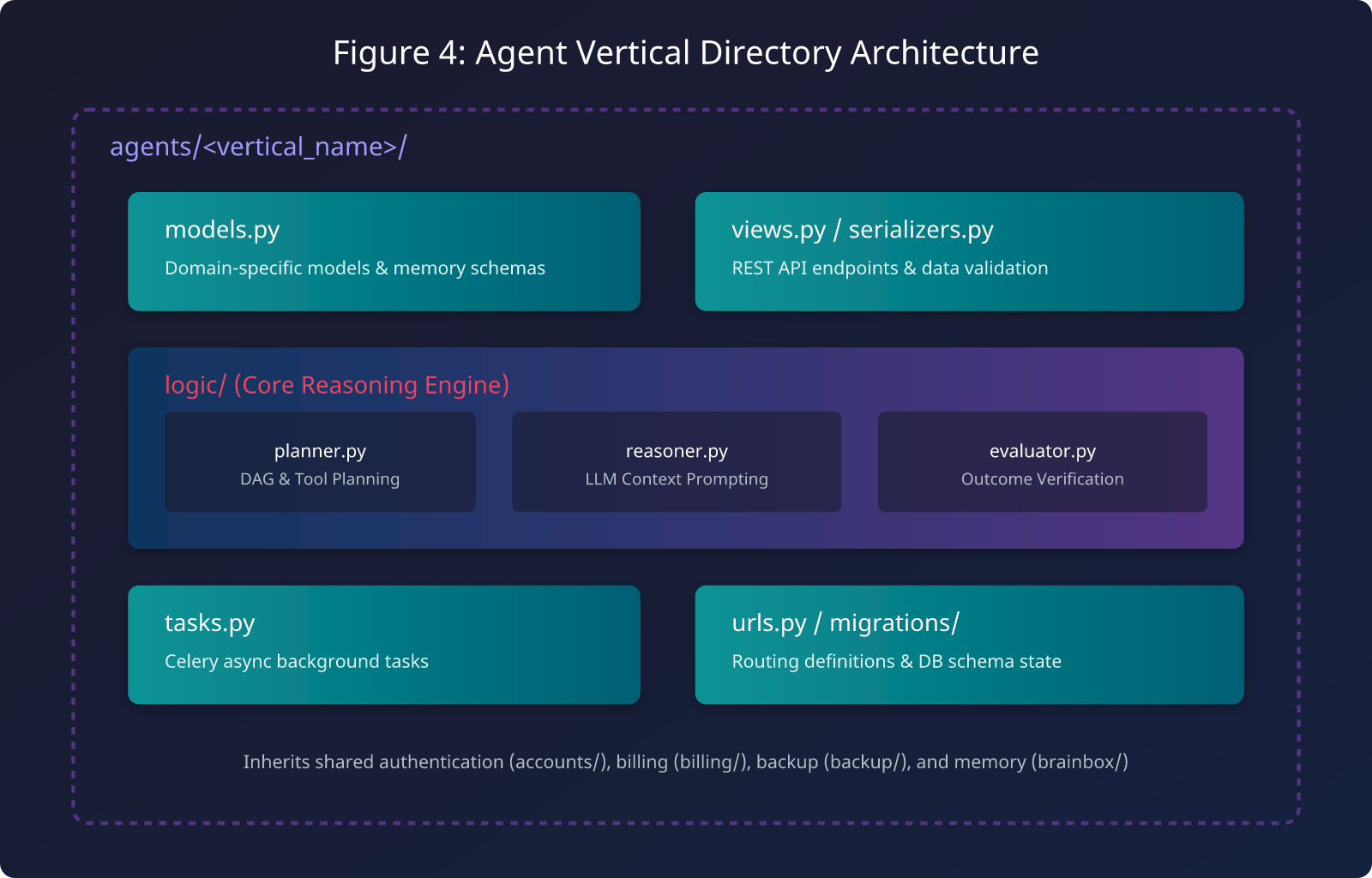
agents/<name>/
├── models.py        # Domain-specific data models
├── views.py         # API endpoints
├── serializers.py   # DRF serializers
├── urls.py          # URL routing
├── tasks.py         # Celery periodic tasks
├── logic/           # Core reasoning engines
└── migrations/
Appendix D: V3/V4 Tool SDK Example
# agentictools/tools/sdk.py
from pydantic import BaseModel
from typing import Optional, Dict, Any

class ToolSchema:
    @staticmethod
    def validate_input(tool, params, strict=False):
        # JSON Schema validation for tool parameters
        schema = tool.input_schema
        # Validation logic...
        return is_valid

class ToolTelemetryEmitter:
    def emit_execution_event(self, tool_name, duration, success, cost):
        # Emit telemetry event to EventBus
        event = {
            'event_type': 'TOOL_FINISHED',
            'tool_name': tool_name,
            'duration_ms': duration,
            'success': success,
            'cost_estimate': cost
        }
        EventBus.publish('TOOL_FINISHED', event)

class ToolHealthMonitor:
    def check_tool(self, tool):
        # Probe tool health and return status
        success_rate = tool.success_count / max(tool.execution_count, 1)
        if success_rate == 1.0:
            return ToolHealth(status='healthy', latency_ms=tool.avg_latency)
        elif success_rate > 0:
            return ToolHealth(status='degraded', latency_ms=tool.avg_latency)
        else:
            return ToolHealth(status='unhealthy', latency_ms=tool.avg_latency)
Appendix E: V3/V4 Skills System Example
# agentictools/skills/skill.py
from dataclasses import dataclass
from typing import List, Dict, Any

@dataclass
class Skill:
    name: str
    description: str
    inputs: List[str]
    outputs: List[str]
    handler: str  # Dotted path to handler function
    tools: List[str]  # Required tools
    prompt_template: Optional[str] = None
    output_schema: Optional[Dict] = None

# Example skill definition
WEBSITE_AUDITOR = Skill(
    name="WebsiteAuditor",
    description="Analyzes website HTML for technographics",
    inputs=["url"],
    outputs=["technologies", "frameworks", "analytics"],
    handler="agentictools.skills.handlers.audit_website",
    tools=["browser", "search"],
    prompt_template="Analyze the website at {url} and extract technographic information...",
    output_schema={
        "technologies": {"type": "array", "items": {"type": "string"}},
        "frameworks": {"type": "array", "items": {"type": "string"}},
        "analytics": {"type": "array", "items": {"type": "string"}}
    }
)
Appendix F: V3/V4 Policy Engine Example
# agentictools/runtime/policy.py
from typing import Dict, Any

class PolicyDecision:
    allowed: bool
    requires_approval: bool
    approver_role: Optional[str]
    reason: str

class PolicyEngine:
    def evaluate(self, agent, action, context) -> PolicyDecision:
        # Load applicable policy rules
        rules = PolicyRuleModel.objects.filter(
            tenant=agent.tenant,
            is_active=True
        ).order_by('-priority')

        for rule in rules:
            if self._matches_rule(rule, agent, action):
                decision = self._apply_rule(rule, action, context)
                if decision.requires_approval:
                    return decision

        return PolicyDecision(allowed=True, requires_approval=False, reason="No matching policy")

    def _matches_rule(self, rule, agent, action):
        # Glob pattern matching for agent_pattern and action_pattern
        import fnmatch
        return fnmatch.fnmatch(agent.name, rule.agent_pattern) and \
               fnmatch.fnmatch(action.type, rule.action_pattern)
Appendix G: V3/V4 Event System Schema
# agentictools/events/types.py
from enum import Enum

class RuntimeEventTypes(Enum):
    INTENT_RECEIVED = "INTENT_RECEIVED"
    PLANNING_STARTED = "PLANNING_STARTED"
    PLAN_GENERATED = "PLAN_GENERATED"
    TOOL_STARTED = "TOOL_STARTED"
    TOOL_FINISHED = "TOOL_FINISHED"
    TOOL_FAILED = "TOOL_FAILED"
    MEMORY_WRITTEN = "MEMORY_WRITTEN"
    MEMORY_READ = "MEMORY_READ"
    KNOWLEDGE_QUERIED = "KNOWLEDGE_QUERIED"
    APPROVAL_REQUESTED = "APPROVAL_REQUESTED"
    APPROVAL_GRANTED = "APPROVAL_GRANTED"
    APPROVAL_DENIED = "APPROVAL_DENIED"
    RUNTIME_BLOCKED = "RUNTIME_BLOCKED"
    RUNTIME_ERROR = "RUNTIME_ERROR"
    WORKFLOW_COMPLETED = "WORKFLOW_COMPLETED"
    WORKFLOW_FAILED = "WORKFLOW_FAILED"
    SESSION_CREATED = "SESSION_CREATED"
    SESSION_CLOSED = "SESSION_CLOSED"
    WORKSPACE_CREATED = "WORKSPACE_CREATED"
    ARTIFACT_CREATED = "ARTIFACT_CREATED"
    AGENT_THINKING = "AGENT_THINKING"
    AGENT_ACTION = "AGENT_ACTION"
    AGENT_ERROR = "AGENT_ERROR"
    SYSTEM_STARTUP = "SYSTEM_STARTUP"
    SYSTEM_SHUTDOWN = "SYSTEM_SHUTDOWN"
    SYSTEM_WARNING = "SYSTEM_WARNING"
    SYSTEM_ERROR = "SYSTEM_ERROR"
Appendix H: V3/V4 Technology Stack
| Component | Technology | Purpose |
|---|---|---|
| Backend Framework | Django 5.0+, Django REST Framework | API, ORM, Auth, Admin |
| ASGI Server | Daphne | WebSocket + HTTP |
| Task Queue | Celery + Redis 7+ | Background execution |
| Database | PostgreSQL 15+ with pgvector | Primary data + vector embeddings |
| Frontend | Next.js 15+ / React 19 / TypeScript | Agent management dashboard |
| AI/LLM | Groq API (Llama 3), DeepL (translation), ElevenLabs (voice) | Intelligence layer |
| Browser Automation | Playwright | Web scraping and interaction |
| Vector Store | pgvector | Semantic memory embeddings |
| Containerization | Docker + Docker Compose | Deployment |
| Reverse Proxy | Caddy | TLS, static files |
| Error Tracking | Sentry | Production monitoring |
| Static Files | WhiteNoise | CDN-ready serving |
| WebSocket | Django Channels / Daphne | Real-time event streaming |
Appendix I: V3/V4 API Schema Examples
Tool Execution API:
POST /api/agentictools/tools/execute/
{
  "tool_name": "email",
  "parameters": {
    "to": "user@example.com",
    "subject": "Invoice Payment",
    "body": "Your invoice has been processed..."
  },
  "agent_id": "monica",
  "workspace_id": "workspace_123"
}
Tenant Agent Creation API:
POST /api/agentictools/tenant-agents/
{
  "name": "Custom Support Agent",
  "description": "Custom customer service agent",
  "agent_type": "hybrid",
  "skill_ids": ["WebsiteAuditor", "InvoiceExtractor"],
  "tool_scope": ["email", "crm", "browser"],
  "trigger_words": ["support", "help", "ticket"],
  "memory_types": ["semantic", "episode", "workspace"],
  "system_prompt": "You are a helpful customer service agent..."
}
Policy Rule Creation API:
POST /api/agentictools/policy/
{
  "agent_pattern": "*",
  "action_pattern": "transfer",
  "constraint_type": "max_amount",
  "constraint_value": {"amount": 10000, "currency": "USD"},
  "requires_approval_from": "finance_manager",
  "priority": 10
}