Whenever a foundation model lab announces a larger context window—moving from 32k to 128k, then 1M and beyond—the industry response is predictable:
"Now we don't need external databases or memory systems. We can just stuff the entire company history into the prompt."
In production engineering, this is a dangerous fallacy.
Expanding context windows does not solve the memory problem for enterprise AI agents. In practice, relying on massive context windows introduces severe operational penalties:
- Quadratic Cost and Latency Spikes: Running an autonomous agent with 500,000 tokens of raw history on every turn means waiting 15 to 45 seconds per inference step and spending dollars instead of fractions of a cent per action.
- Attention Degradation (The "Lost in the Middle" Effect): As context length increases, a model's ability to recall specific facts buried in the middle of a massive prompt degrades significantly.
- No Cross-Session or Cross-Agent Persistence: Context windows evaporate the second an API session terminates. When another agent spawns to pick up the next shift, it starts from complete amnesia unless state is saved elsewhere.
A context window is working RAM. It is not long-term storage.
To build autonomous agents that learn, retain institutional knowledge, and collaborate across departments, you need a persistent memory substrate.
The Four Tiers of Enterprise Agent Memory
A production memory architecture cannot treat all information as an undifferentiated stream of conversational text. It must organize data into four distinct operational tiers:
┌─────────────────────────────────────────────────────────────┐
│                 ENTERPRISE MEMORY TAXONOMY                  │
│                                                             │
│  [ TIER 01: WORKING MEMORY ]                                │
│  - Active prompt scratchpad, current tool outputs           │
│  - Lifespan: Current execution step only                    │
│                                                             │
│  [ TIER 02: EPISODIC MEMORY ]                               │
│  - Structured logs of past workflow runs, errors, decisions │
│  - Lifespan: Days to months (Time-series audit store)       │
│                                                             │
│  [ TIER 03: SEMANTIC MEMORY ]                               │
│  - Unstructured corporate corpora, manuals, technical docs  │
│  - Storage: Dense vector embeddings (vector retrieval engine)          │
│                                                             │
│  [ TIER 04: RELATIONAL KNOWLEDGE GRAPHS ]                   │
│  - Entities, permissions, organizational structures, rules  │
│  - Storage: Graph triples (Subject -> Predicate -> Object)  │
└─────────────────────────────────────────────────────────────┘
1. Working Memory (Scratchpad)
This is the immediate context window. It contains the current task objective, the system instructions, and the raw output of the most recent tool execution. Once the step completes, relevant data is synthesized and extracted; the raw fluff is discarded.
2. Episodic Memory (Experience Log)
How did the agent resolve an edge-case invoice dispute last Tuesday? Episodic memory stores structured traces of previous workflow runs: what the input was, what steps were taken, which tool failed, and how the problem was resolved.
When an agent encounters an identical error next month, it retrieves the past episode rather than reinventing the troubleshooting procedure.
3. Semantic Memory (Vector Search)
Semantic memory handles unstructured documentation: policy handbooks, vendor contracts, internal wikis, and technical runbooks. Text is chunked, embedded into dense vector representations, and indexed for approximate nearest-neighbor search.
When an agent needs to review clause 4.2 of an NDA, it performs a targeted vector similarity query and injects only that specific paragraph into its working memory.
4. Relational Memory (Knowledge Graphs)
Vector search alone is insufficient for relational business logic.
If an agent queries: "Who can approve a payment to Acme Corp exceeding $10,000 for European operations?", a vector search will return generic documents mentioning "payments" and "approvals."
A Knowledge Graph represents this deterministically through typed relationships:
(User: Sarah) --[:IS_ROLE]--> (Role: Regional VP)
(Role: Regional VP) --[:AUTHORIZATION_LIMIT]--> (Threshold: $50,000)
(Role: Regional VP) --[:JURISDICTION]--> (Region: EMEA)
(Vendor: Acme Corp) --[:LOCATED_IN]--> (Region: EMEA)
A graph traversal provides the exact, deterministic answer in milliseconds without relying on probabilistic model guesses.
Hybrid Graph-Vector Substrates
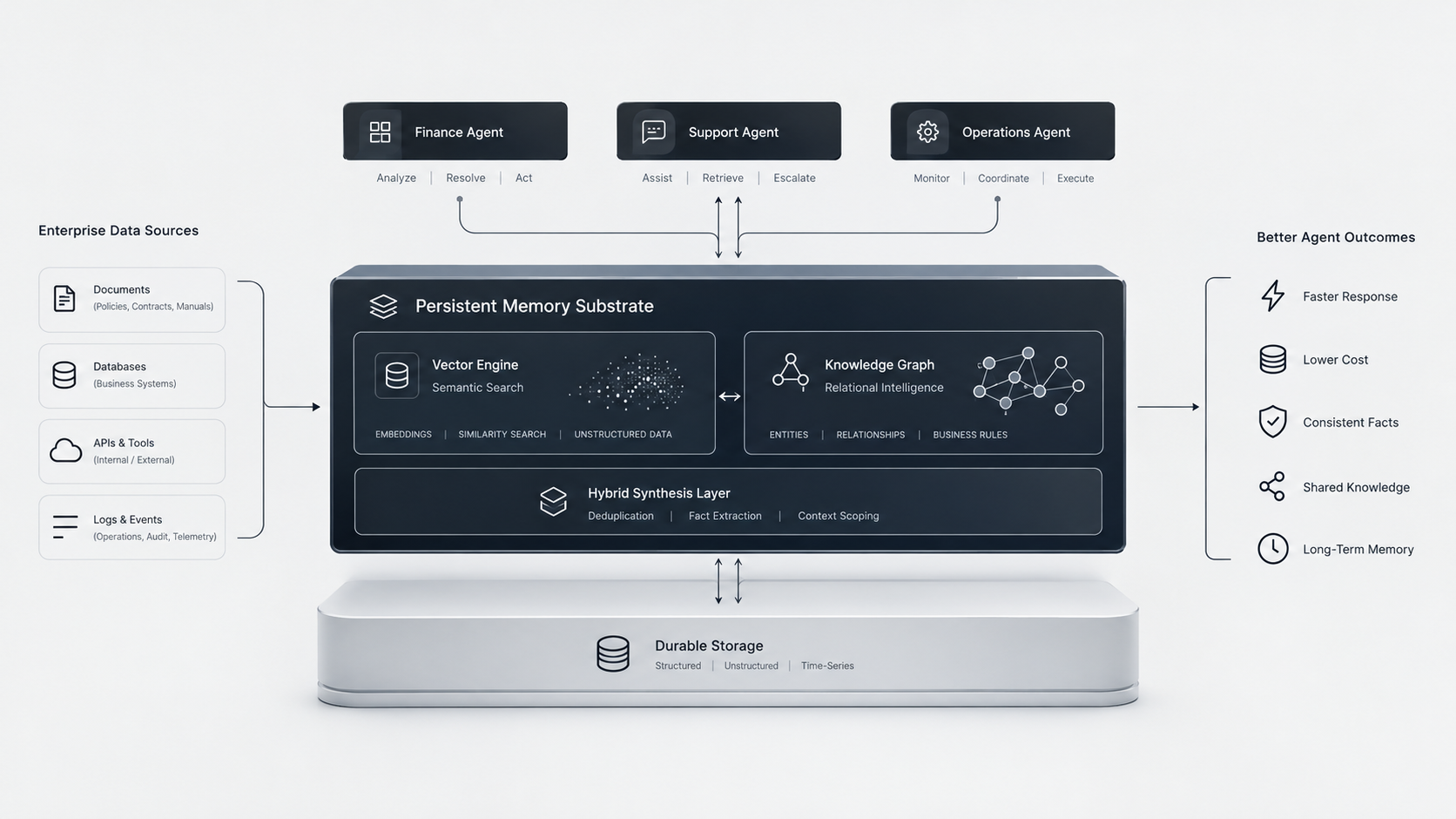
In practice, a persistent memory substrate combines semantic vector indexing with explicit relational knowledge graphs, operating as a shared intelligence layer across an agent workforce.
A persistent memory substrate combines semantic vector indexing with explicit relational knowledge graphs, operating as a centralized intelligence layer across your entire agent workforce.
                     AUTONOMOUS AGENTS
        [ Agent A (Finance) ]     [ Agent B (Support) ]
                  │                         │
                  └────────────┬────────────┘
                               │ Structured Query
                               ▼
                   PERSISTENT MEMORY SUBSTRATE
   ┌───────────────────────────────────────────────────────┐
   │                                                       │
   │   ┌─────────────────────┐   ┌─────────────────────┐   │
   │   │    VECTOR ENGINE    │   │   KNOWLEDGE GRAPH   │   │
   │   │  (Semantic Content) │   │ (Entity Relations)  │   │
   │   └──────────┬──────────┘   └──────────┬──────────┘   │
   │              │                         │              │
   │              └────────────┬────────────┘              │
   │                           ▼                           │
   │                HYBRID SYNTHESIS LAYER                 │
   │            (Deduplication & Fact Scoping)             │
   └───────────────────────────┬───────────────────────────┘
                               │
                               ▼ Injected Context
                     FOUNDATION MODEL RUNTIME
                    (Compact, High-Signal Prompt)
How Memory Substrates Change Agent Economics
- Up to 70% reduction in prompt tokens: Instead of resending thousands of tokens of chat history on every turn, the runtime queries the memory substrate for the exact facts required for the immediate step. Prompts remain lightweight, latency drops, and API costs fall.
- Cross-agent intelligence transfer: When an investigation agent discovers that a supplier's banking details changed, it updates the shared substrate. Moments later, an invoicing agent executing a payment automatically accesses the updated record. There is no siloed agent amnesia.
- Fact Extraction and Automatic Deduplication: Raw logs and conversational text are processed asynchronously by background synthesis pipelines, extracting entities, relations, and outcomes while purging temporary conversational fluff.
Why Memory Depends on Data Infrastructure
A memory substrate is only as good as its underlying data infrastructure.
That infrastructure handles distributed vector indexing, real-time data ingestion, and structured analytical queries at enterprise scale.
By pairing an agent runtime with high-throughput data infrastructure, organizations provide their autonomous agents with instantaneous access to large-scale data lakes without choking inference pipelines.
Architectural Takeaway
Relying on ever-expanding LLM context windows to solve enterprise memory is a dead end. It is expensive, slow, and operationally fragile.
Production agents need structured, tiered memory: working scratchpads for immediate actions, vector search for reference corpora, and knowledge graphs for relational business rules.
When you decouple memory from the model context window, agents become faster, cheaper to run, and capable of retaining institutional knowledge across months of complex enterprise operations.
Persistent memory is a long-running research thread in this series rather than a single technique. Pluggedspace treats it as substrate infrastructure that the remaining foundations on reliability and governance can assume.
- Deepen Your System Design: Read our architectural breakdown on Multi-Agent Systems: Architecture and Deterministic Coordination.
- Explore Labs Research: Read related memory systems research in Pluggedspace Labs.