When you write 2 + 2 in Python, you expect 4 every single time.
If your core accounting software returned 4 on Monday, 5 on Tuesday because the temperature parameter drifted, and 3.999 on Wednesday because the context window was crowded, your business would be shut down by regulators within a week.
This highlights the fundamental tension at the heart of enterprise AI automation:
- Enterprise Operations are Deterministic: Ledgers, inventory systems, payroll pipelines, and healthcare records require 100% mathematical consistency, strict transactional boundaries, and total auditability.
- Foundation Models are Probabilistic: Large language models predict the next most likely token based on probabilistic weights. They are flexible, creative, and capable of synthesizing complex context, but they are inherently non-deterministic.
Attempting to force a probabilistic model to act as a deterministic state machine through prompt engineering alone is a mistake.
To build reliable enterprise automation, you must engineer a clean separation of concerns between probabilistic reasoning and deterministic execution.
The Separation of Concerns
The architectural solution is to treat foundation models as cognitive advisors, never as direct execution kernels.
┌─────────────────────────────────────────────────────────────┐
│                 PROBABILISTIC REASONING LAYER               │
│                                                             │
│   - Context synthesis, classification, hypothesis           │
│   - Unstructured document parsing & plan proposal           │
│   - Model output: Strictly typed JSON proposal              │
└──────────────────────────────┬──────────────────────────────┘
                               │
                               ▼ Typed Intent Contract (JSON Schema)
┌──────────────────────────────┴──────────────────────────────┐
│                 DETERMINISTIC EXECUTION LAYER               │
│                                                             │
│   - State machine verification & business invariants        │
│   - Idempotency token checking                              │
│   - Role-based authorization & spending limits              │
│   - Transaction commits and rollback logs                   │
└──────────────────────────────┬──────────────────────────────┘
                               │
                               ▼ Verified Mutation
                   ENTERPRISE SYSTEMS OF RECORD
              (PostgreSQL, SAP, Salesforce, Cloud APIs)
In this hybrid architecture:
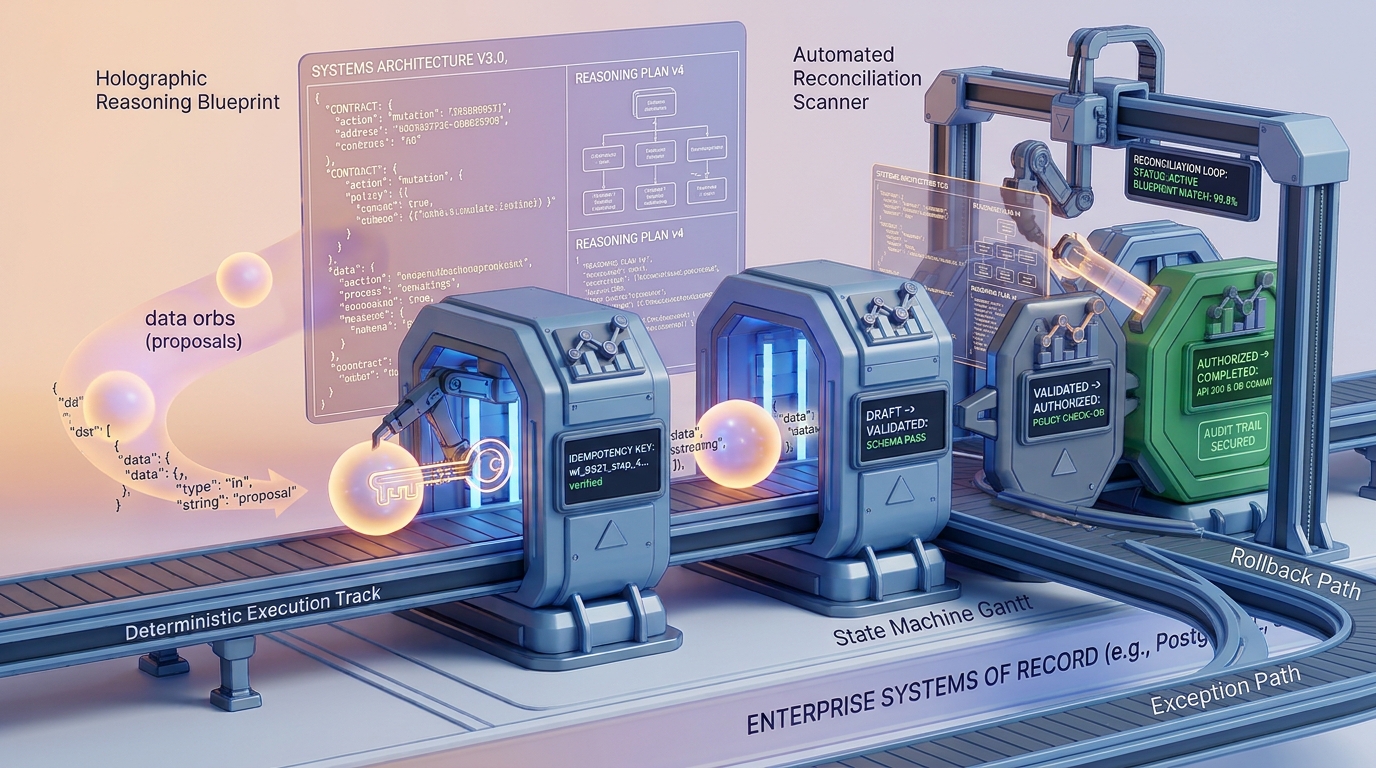
- The Reasoning Layer (Probabilistic): The model reads messy customer emails, extracts unstructured invoice fields, analyzes error logs, and drafts a proposed course of action.
- The Contract Boundary (Typed Schema): The model emits its proposed plan as a strictly typed JSON payload adhering to a predefined schema.
- The Execution Layer (Deterministic): Traditional, deterministic software validates the payload against company invariants, verifies permissions, checks financial thresholds, and commits the mutation to enterprise databases.
The model proposes the intent. Deterministic software verifies and executes the transaction.
Three Engineering Rules for Hybrid AI Reliability
Deploying probabilistic models into production operations requires three engineering safeguards:
1. Mandatory Idempotency on Every Tool Invocation
In distributed systems, network packets drop, external APIs time out, and retries occur constantly.
If an agent attempts to charge a customer's credit card or create a new purchase order, what happens if the network connection drops before the confirmation arrives?
An unmanaged agent script might rerun the step and issue a duplicate charge.
A deterministic execution layer enforces idempotency keys on every mutation tool call:
POST /api/v1/settlements HTTP/1.1
Host: billing.internal.enterprise
Idempotency-Key: wf_9921_step_4_8f1b2c
Content-Type: application/json

{
  "account_id": "ACC-49102",
  "amount_cents": 12500,
  "reason": "Rebate applied for SLA downtime"
}
If the execution layer retries the tool call, the receiving server recognizes the idempotency key and returns the cached result of the original transaction without duplicating the mutation.
2. State-Machine Verification
An autonomous agent must never transition between operational states based solely on its own conversational assessment (such as saying "I have completed the verification").
State transitions must be governed by explicit state machines:
[ DRAFT ] ──( Schema Validated )──> [ VALIDATED ]
                                          │
                             ( Policy Check Passed )
                                          │
                                          ▼
                                   [ AUTHORIZED ]
                                          │
                             ( API 200 OK + Commit )
                                          │
                                          ▼
                                   [ COMPLETED ]
Each state transition requires programmatic proof:
- Moving from
DRAFTtoVALIDATEDrequires a cryptographic schema pass. - Moving from
VALIDATEDtoAUTHORIZEDrequires policy gate verification. - Moving from
AUTHORIZEDtoCOMPLETEDrequires an HTTP 200 receipt and a database commit hash.
If any check fails, the state machine halts or transitions to ESCALATED, preventing corrupted states from rippling across internal systems.
3. Automated Reconciliation Loops
In mission-critical enterprise infrastructure, you cannot assume that an agent's mental model matches ground reality.
Deterministic systems employ background reconciliation loops (similar to Kubernetes controllers):
- The reconciliation worker continuously compares the desired state (what the agent planned) against the actual state (what exists in the database).
- If a discrepancy is detected—for example, if an inventory count was decremented but the corresponding sales order is missing—the system flags the inconsistency and executes an automated rollback or alerts an on-call engineer.
Systems for Complex Operations
The core architectural thesis is:
Reliable enterprise automation bridges probabilistic AI intelligence with deterministic enterprise infrastructure.
Generic chatbots or unconstrained script loops cannot carry that load. The work requires an operational control plane:
- Deterministic execution layer: DAG scheduling, persistent memory, and zero-trust policy gates that separate reasoning from execution.
- High-throughput data infrastructure: Real-time data ingestion, vector indexing, and analytical verification that keep agents grounded in current state.
By coupling runtime control with sound data infrastructure, organizations safely operationalize probabilistic AI models across complex, high-stakes business environments.
Architectural Takeaway
Large language models represent a generational breakthrough in reasoning, synthesis, and planning. But enterprise software cannot run on probabilities alone.
The secret to reliable AI automation is not hoping the model gets smarter with better prompt engineering.
The secret is systems engineering: wrapping probabilistic reasoning inside deterministic execution layers that enforce schemas, guarantee idempotency, validate state transitions, and maintain immutable audit trails.
Separating reasoning from execution is the reliability thesis behind the foundations series. Pluggedspace articulates it here so the companion pieces on production readiness and governance share the same architectural premise.
- Deepen Your Knowledge: Read our flagship analysis on What Makes an AI Agent Production-Ready?.
- Explore Labs Research: Read related systems research in Pluggedspace Labs.