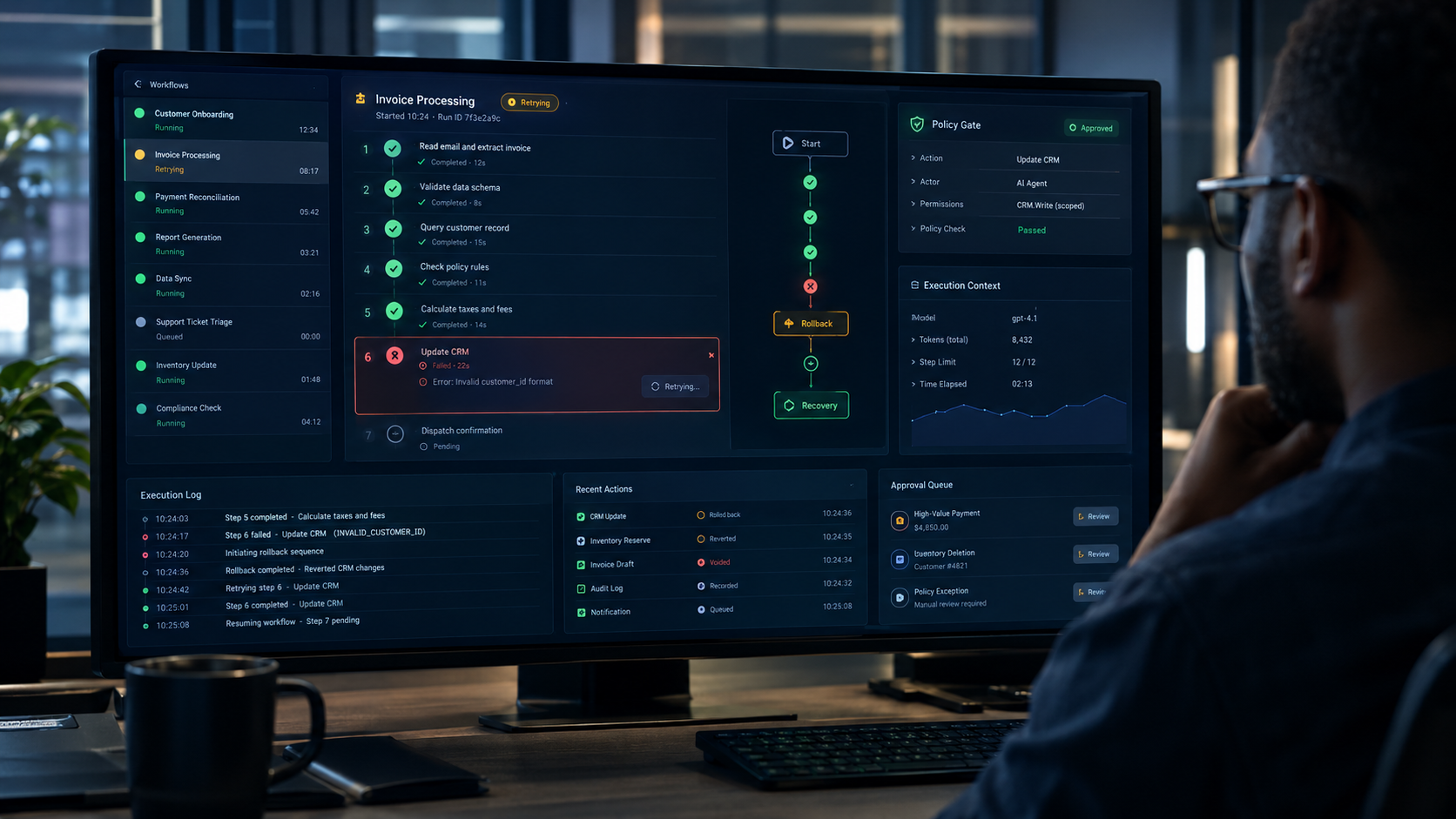
If an engineer builds a traditional database integration that fails one out of every ten times, that integration is broken. It would never survive code review, let alone reach production.
Yet in the AI industry, models boasting a 90% success rate on benchmark evaluations are regularly hailed as state-of-the-art.
For a single-turn question-and-answer chatbot, a 90% success rate feels acceptable. For an autonomous multi-step agent executing real work across enterprise software, that same number is a disaster.
Consider the compounding mathematics of autonomous workflows:
$$\text{Workflow Success Rate} = (\text{Single-Step Reliability})^N$$
If a business process requires an agent to execute 10 sequential steps—reading an email, querying a database, parsing an invoice, checking policy rules, calculating taxes, updating the CRM, and dispatching a confirmation:
- At 90% single-step accuracy: $0.90^{10} \approx \mathbf{34.8%}$ overall success rate. The agent fails nearly two out of every three runs.
- At 95% single-step accuracy: $0.95^{10} \approx \mathbf{59.8%}$ overall success rate. The agent fails four out of every ten runs.
- Even at 99% single-step accuracy: $0.99^{10} \approx \mathbf{90.4%}$ overall success rate. One out of every ten customer transactions experiences an error.
┌─────────────────────────────────────────────────────────────┐
│             THE COMPOUNDING FAILURE OF SCRIPT LOOPS         │
│                                                             │
│   Step 1 (90%) -> Step 2 (81%) -> Step 3 (73%) ...          │
│                                           │                 │
│                                           ▼                 │
│                              Step 10 = ~35% Survival Rate   │
│                                                             │
│   Without deterministic failovers and checkpoints,          │
│   autonomous agents cannot survive multi-step execution.    │
└─────────────────────────────────────────────────────────────┘
An AI agent is not production-ready when it demonstrates a clever demo video.
An AI agent is production-ready when its worst-case failure mode is bounded, deterministic, and recoverable.
The 6 Non-Negotiables of Production AI Agents
Before granting an autonomous agent write access to enterprise systems of record (SAP, PostgreSQL, Salesforce, HubSpot), software architects must verify six structural criteria:
1. Hard Execution Bounds and Wall-Clock Ceilings
Unmanaged agents can easily enter infinite loops when faced with ambiguous instructions or unexpected API errors.
A production agent must run inside a strict execution envelope:
- Maximum Step Limit: Hard cap on the number of tool invocations per workflow (e.g., maximum 12 steps).
- Token Budget Ceilings: Absolute limit on cumulative tokens consumed. If a runaway reasoning chain consumes 100,000 tokens without resolving, the runtime terminates the process.
- Wall-Clock Deadlines: Explicit timeout bounds per step and per workflow.
2. Strictly Typed Schema Validation on All Tool I/O
A foundation model must never pass free-form natural language strings directly into internal database queries or third-party APIs.
Every tool call must enforce formal schemas:
- Tool parameters must parse cleanly into typed models (such as Pydantic or JSON Schema).
- Tool return values must be verified before the runtime re-injects them into downstream reasoning context.
- If a model returns malformed JSON, the execution engine intercepts the error, provides targeted schema feedback, and triggers a deterministic retry without crashing the workflow.
3. Isolated Sandboxed Execution Environments
An agent executing code or handling data across different enterprise customers or business units must run in an isolated environment.
This requires:
- Ephemeral containers or secure microVM boundaries for code execution.
- Strict network egress filtering: agents can only communicate with whitelisted enterprise endpoints.
- Role-based credential scoping: the agent receives temporary, least-privilege tokens for target APIs rather than global admin API keys.
4. Deterministic Checkpoints and Compensatory Rollbacks
In modern transaction processing, operations adhere to ACID guarantees. If step six of a workflow fails, you cannot leave steps one through five hanging.
If an agent reserves inventory and drafts an invoice in Stripe, but the payment gateway rejects the transaction:
- The system must capture the state snapshot at step five.
- It must execute compensatory actions (releasing the reserved inventory and voiding the draft invoice).
- It must record the exact reason for the failure in an immutable incident log.
5. Zero-Trust Policy Gates for Consequential Mutations
Probabilistic models should never have direct, unvetted authority to modify critical systems of record or authorize financial transactions.
A production agent operates under a clear separation of concerns:
Model Proposes Action -> Policy Gate Validates Invariants -> System Executes
If an agent proposes issuing a $5,000 payment or deleting a customer record, the action is routed through a deterministic policy gate. If the parameters exceed pre-authorized permissions, the gate halts execution and escalates the decision to a human supervisor.
6. Immutable End-to-End Audit Telemetry
When an autonomous agent makes a decision that impacts business operations, engineering and compliance teams must be able to reconstruct every millisecond of the decision path:
- Which prompt version and model checkpoint was invoked?
- What exact context was retrieved from memory?
- What parameters were sent to external APIs?
- Which policy rules were evaluated?
- Who signed off on the escalation?
Without full auditability, deploying autonomous systems introduces unacceptable compliance and liability risks.
Production Readiness Checklist for Enterprise IT
Use this checklist before deploying any autonomous agent into a live business workflow:
| Architectural Requirement | Prototype Script | Production Standard |
|---|---|---|
| Error Recovery | Script crashes on 500 error | Automated retry with exponential backoff & state checkpoint |
| Mutation Authority | Agent calls write APIs directly | Zero-Trust policy gate evaluates every write operation |
| Context Management | Raw conversation stuffed into prompt | Tiered memory with fact extraction |
| Execution Bounds | Open while loop |
Hard caps on steps, tokens, and wall-clock time |
| Audit Trail | Ephemeral print() logs |
Immutable execution traces stored in audit database |
| Human Escalation | Ad-hoc or absent | Structured dual-key approval triggers on policy breach |
Production Readiness in Practice
In practice, a production runtime turns fragile agent scripts into enterprise-grade operational infrastructure:
- DAG Swarm Orchestration: Decomposes complex workflows into verifiable state machines that eliminate infinite loops.
- Automated Checkpoints & Rollbacks: Guarantees database integrity even when third-party APIs fail.
- Zero-Trust Governance Kernel: Enforces strict role-based access control and financial spending limits on every agent action.
- Step-by-Step Execution Tracing: Provides full replayability, token analytics, and compliance audit logs for every autonomous agent in your organization.
Architectural Takeaway
Building an AI agent that works 90% of the time is easy.
Building an agentic system that operates reliably inside an enterprise requires engineering around the 10% failure rate: deterministic failovers, state checkpoints, strict schemas, and zero-trust policy gates.
True production readiness is not defined by how well an agent reasons under optimal conditions. It is defined by how safely and predictably the system behaves when conditions go wrong.
This checklist states the production bar the rest of the foundations series assumes. Pluggedspace publishes it as a shared reference so reliability discussions can start from explicit criteria rather than demos.
- Understand the Operating Layer: Read our complete guide on Why AI Agents Need an Operating Layer.
- Explore Labs Research: Read related reliability research in Pluggedspace Labs.