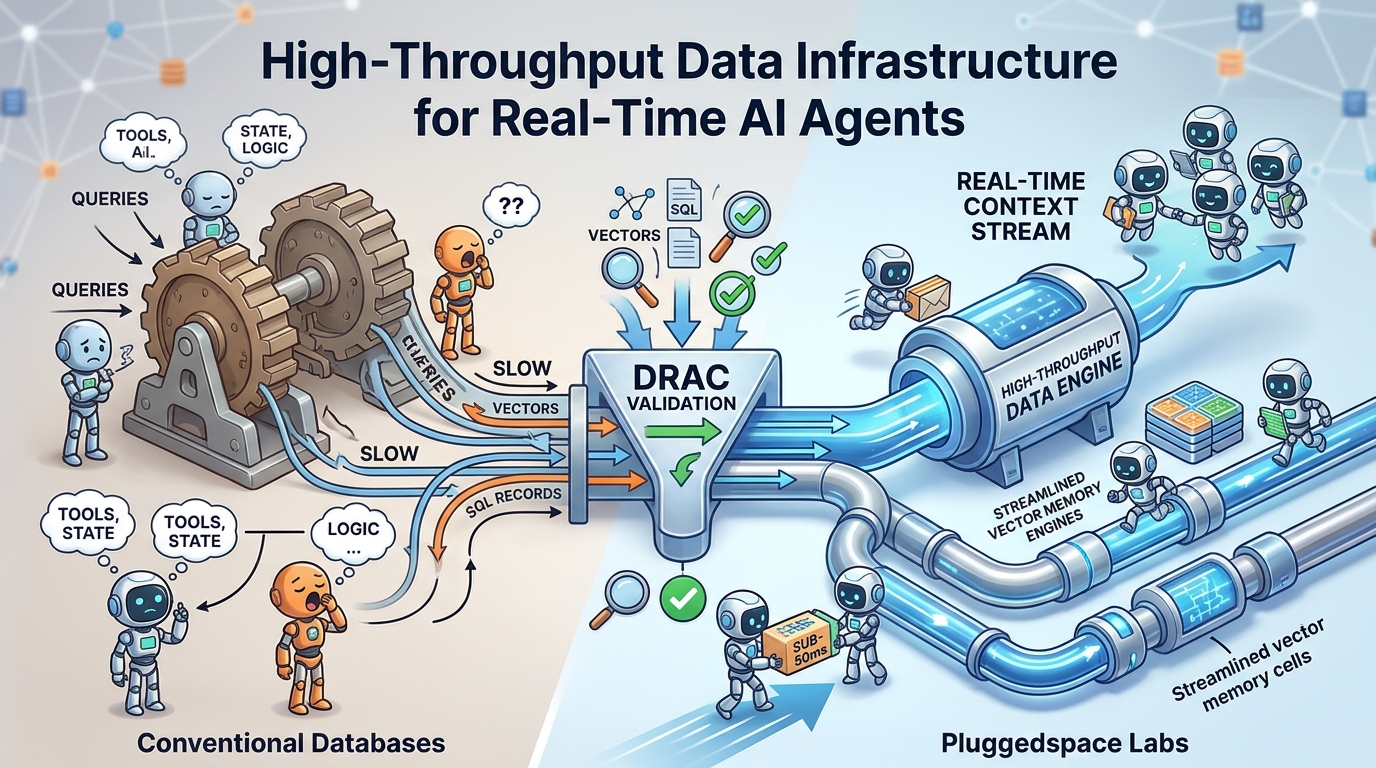
Most enterprise data infrastructure was designed around human read-write patterns.
A human employee opens a dashboard, submits a form, or runs an analytical report every few minutes. Relational databases, connection pools, and traditional caching layers handle that traffic with ease.
When you deploy a fleet of fifty autonomous AI agents, that traffic pattern changes completely.
A single multi-agent workflow might execute thirty sequential tool calls across five systems. Multiply that by dozens of concurrent business processes, and your data layer is suddenly hit with thousands of complex operations per minute:
- Concurrent semantic vector similarity searches across millions of documents.
- High-frequency streaming writes of agent reasoning traces, episodic logs, and state snapshots.
- Real-time analytical aggregations joining unstructured embeddings with structured SQL records.
Conventional database architectures quickly bottleneck under this workload. Query latencies spike from 20 milliseconds to 3 seconds, agents stall waiting for context, and multi-agent coordination grinds to a halt.
To run autonomous agents at enterprise scale, you need high-throughput data infrastructure engineered specifically for agentic workloads.
The Three Data Bottlenecks of Multi-Agent Systems
When scaling agent fleets beyond initial proof-of-concepts, engineering teams run into three structural bottlenecks at the data layer:
┌─────────────────────────────────────────────────────────────┐
│                 THE AGENT DATA BOTTLENECK                   │
│                                                             │
│   [ 50 Concurrent Autonomous Agents ]                       │
│        │                 │                 │                │
│        ▼                 ▼                 ▼                │
│   Vector Read       Trace Writes      SQL Joins             │
│   (Semantic Search) (Episodic State)  (Relational Ledger)   │
│        │                 │                 │                │
│        └─────────────────┼─────────────────┘                │
│                          │                                  │
│                          ▼                                  │
│           CONVENTIONAL DATABASE UNDER DURESS                │
│           - High latency: Agents stall mid-workflow         │
│           - Lock contention on concurrent writes            │
│           - Expensive index recalculation                   │
└─────────────────────────────────────────────────────────────┘
1. Vector Retrieval Latency and Stalling Agents
When a human searches a knowledge base, waiting 800 milliseconds for a vector search result is barely noticeable.
When an agent needs to retrieve context at four distinct nodes within an automated execution DAG, that latency compounds. If each vector lookup takes nearly a second, the agent spends more time idling on database I/O than on model inference.
Agentic workloads require vector similarity lookups to return in under 50 milliseconds, even under heavy concurrent load.
2. High-Frequency Write Contention on Execution Traces
Every autonomous agent must record its intermediate steps: what prompt was sent, which tools were called, what output was returned, and which policy checks were evaluated.
If hundreds of agent threads write these verbose JSON traces into a standard relational database without write-optimized ingestion pipelines, connection pools exhaust, row locks contend, and the database slows down for other business operations.
3. Data Integrity and Verification (The "Garbage In, Garbage Out" Problem)
AI agents generate new data: summarized documents, classification labels, updated customer profiles, and synthetic records.
If this newly generated data is written back into corporate data lakes without strict validation, downstream agents train or retrieve corrupted facts. Within weeks, the enterprise knowledge base becomes polluted with compounding model hallucinations.
The Architecture of an Agent-Scale Data Engine
Solving these bottlenecks requires purpose-built data infrastructure designed to handle verified ingestion, rapid analytical querying, and distributed vector indexing.
               ENTERPRISE DATA SOURCES
       (Postgres, Parquet, Cloud Lakes, APIs)
                          │
                          ▼
            INGESTION & DRAC VALIDATION
    ┌──────────────────────────────────────────┐
    │ Schema Check -> Anomaly Detection -> QA  │
    └─────────────────────┬────────────────────┘
                          │ Verified Datasets
                          ▼
            DUCKDB & HIGH-PERFORMANCE SQL
    ┌──────────────────────────────────────────┐
    │ Analytical aggregations, fast Parquet    │
    │ queries, sub-millisecond table filters   │
    └─────────────────────┬────────────────────┘
                          │
             ┌────────────┴────────────┐
             ▼                         ▼
     VECTOR EMBEDDING          PREDICTIVE ENGINES
     (High-Throughput           (Time-Series Forecasts,
      Similarity Index)          General ML Models)
             │                         │
             └────────────┬────────────┘
                          │
                          ▼
             HIGH-SPEED INTELLIGENCE API
          (Sub-50ms Context for Agent Fleets)
1. Verification Before Ingestion (DRAC)
Data must never enter an agent's memory substrate without validation.
At Pluggedspace, our data infrastructure employs DRAC (Data Reliability & Governance):
- Schema Validation: Ensures incoming records match expected structural types before storage.
- Anomaly Detection: Flags statistical outliers and corrupt inputs in streaming data feeds.
- Data Quality Scoring: Computes a composite reliability score (0–100) for every dataset. Datasets below the required threshold are blocked from agent retrieval.
2. Analytical Engine Integration (DuckDB & Parquet)
Instead of forcing every query through expensive cloud data warehouses, agent infrastructure leverages embedded analytical engines like DuckDB querying columnar Parquet files directly.
This allows agents to run analytical aggregations—such as calculating average vendor settlement variances over 500,000 historical records—in milliseconds, directly within the local runtime envelope.
3. Compressed-Domain Indexing: Research from Pluggedspace Labs
In traditional vector systems, high-dimensional vector embeddings consume massive RAM and require substantial compute during distance calculations.
In Pluggedspace Labs, our systems research focuses on compressed-domain data processing:
- Indexing and calculating similarity metrics directly on compressed vector representations without full decompression cycles.
- Reducing vector memory footprints by up to 60% while maintaining search precision.
- Slashing index rebuild times, allowing real-time data to be searchable by agents the instant it is verified.
What High-Throughput Infrastructure Must Provide
In practice, intelligent data infrastructure serves as the data layer for complex enterprise operations.
                   PLUGGEDSPACE ECOSYSTEM
                             │
             Systems for Complex Operations
                             │
        ┌────────────────────┴────────────────────┐
        ▼                                         ▼
   DATA INFRASTRUCTURE                       AGENT RUNTIME
(Data Ingestion, Validation,             (Agent Execution,
Vector Search & Analytics)               Memory & Governance)
        │                                         ▲
        └───────────────────┬─────────────────────┘
                            │ Sub-50ms Context Stream
                            ▼
               AUTONOMOUS ENTERPRISE AGENTS
While the operating layer manages agent execution, lifecycle, and governance, the data engine underneath:
- Ingests streaming enterprise data across databases, APIs, and cloud lakes.
- Validates data integrity via DRAC before passing it to agent memory.
- Provides high-throughput vector retrieval and predictive modeling through machine-readable Intelligence APIs.
Architectural Takeaway
Autonomous AI agents are only as capable as the data infrastructure supporting them.
If your data layer is slow, unverified, or choked by write contention, your agent workforce will be slow, unreliable, and prone to cascading errors.
Building production agentic systems requires high-throughput data pipelines: sub-50ms vector search, columnar analytical querying, pre-ingestion reliability validation, and compressed-domain indexing.
When you engineer the data engine correctly, your agents gain real-time access to organizational intelligence without creating infrastructure bottlenecks.
High-throughput infrastructure is what lets the rest of this series hold at enterprise scale. Pluggedspace connects it here to orchestration and memory so data systems read as operational foundations rather than background tooling.
- Read Labs Research: Review technical findings on compressed-domain processing and data systems in Pluggedspace Labs.
- Continue the Foundations: Read AI Agent Memory: From Context Windows to Persistent Memory Substrates.